When a customer looks for you somewhere else
A social page can work for people who already follow you, but not every buyer starts there. A referral customer may hear your name at a school event, in a neighborhood group, or from a previous client, then go straight to search or text a link to a spouse. If they land on a clean website with your services, service area, and phone number, that moment feels easier than trying to scroll through a feed for basic details.
Hypothetical example: a homeowner hears that a local company can handle a repair and types the business name into search on a lunch break. On Facebook, they might only see recent posts and comments. On a website, they can confirm the business identity, see what the company actually does, and decide whether to call now or save the number for later.
What a homepage should say fast
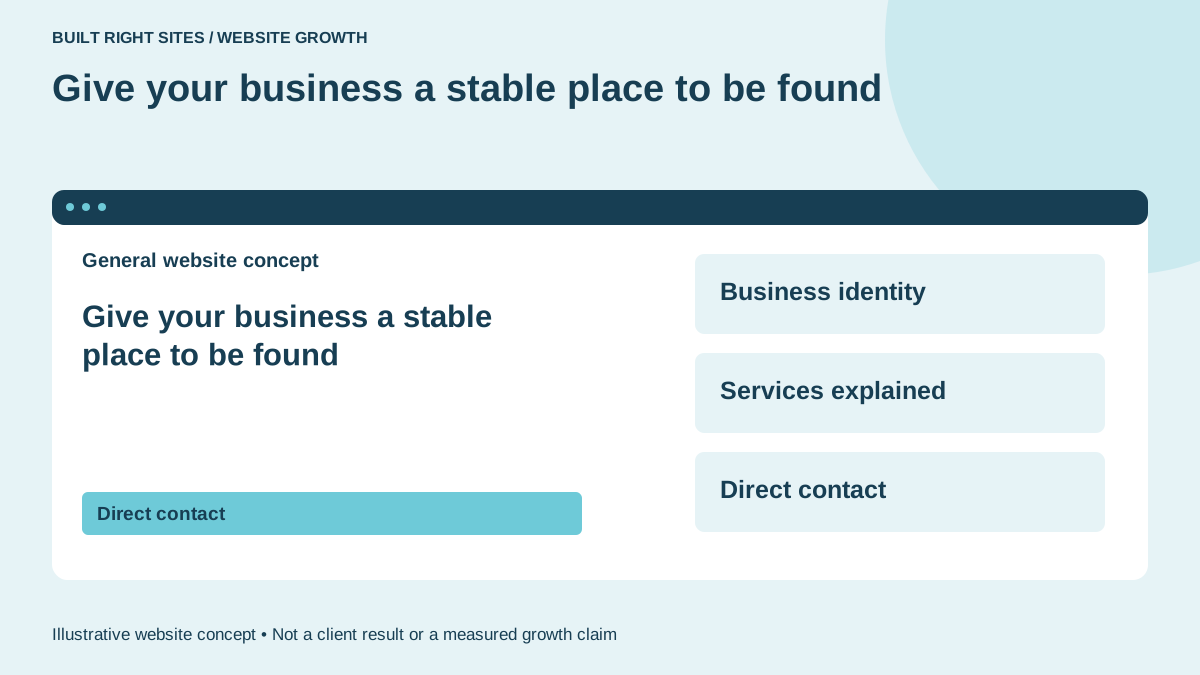
The homepage does not need to do everything. It needs to answer a few practical questions quickly: who you are, what you do, where you work, and how someone reaches you. If those points are easy to find, a visitor can move from curiosity to action without hunting through posts or guessing whether the business is still active.
For a local owner, that often means clear service descriptions, a simple contact path, and a short explanation of the kinds of jobs you take on. A website can also help people who are comparing options understand the difference between a quick social update and a stable informational destination. People-first content matters, and the main job is usefulness, not decoration.
Explore Built Right Sites website examples for an example of how this can work on a site.
Search and discovery without overpromising
A website can support discovery because people often use search when they are ready to compare or contact a business. That does not mean a site automatically creates traffic or rankings. It means your business has a place to appear when someone searches for your name, service type, or location, instead of relying only on a social feed that may not be easy to navigate.
If you have ever wondered whether a website can help your business grow beyond Facebook, the honest answer is yes in a practical sense: it gives people another way to find and understand you. It also helps with visitors who do not use social media much, or who do not want to log in just to read a phone number, hours, or service description. Search engines index content, but results remain uncertain.
For the next part of this process, read Give Instagram visitors a useful website.
A simple buyer journey, before and after
Before: a customer sees a Facebook post, forgets the business name, and comes back later only to find that the page is buried under older updates. They still have a question, but they cannot tell whether the company serves their area or handles their type of job. The opportunity fades because the information was scattered across posts instead of organized on one site.
After: the same person remembers the business name, searches it, and lands on a homepage that clearly lists services, service area, and a direct phone number. They do not have to read a long story or scroll through a feed. They can decide whether to call, submit a message, or move on. That is the real value of a website for many local businesses: making the next step obvious.
Keeping Facebook and a website in the right roles
You do not have to choose between the two as if one replaces the other. Facebook can still help you stay visible to existing followers, share updates, and show the personality behind the business. A website can hold the information people need when they are actively checking whether to hire you. Those roles are different, and that difference is often the point.
The tradeoff is maintenance. A feed can ask for constant posting, while a website asks for clarity and upkeep on the pages that matter most. If you are thinking about a new business website, consider whether it reflects your services in a more stable way than social alone can. Built Right Sites can create a homepage concept before you decide to pay, which makes it easier to picture that shift without overcommitting early.
For a local business owner, the question is usually not whether Facebook works at all, but whether it is the only place people can verify and contact you. A website gives customers a straightforward destination when they are ready to learn, compare, and call, even though it does not guarantee demand or results on its own.
Related articles
- Give Instagram visitors a useful website
- The Website plan is $399 one time, with no required monthly fee: up to 6 service pages, 10 service-area pages and 2 website tools. Hosting is optional at $9/month, or take the finished files and arrange your own hosting. AI tools are an optional, separately quoted add-on. Website + Marketing is $699/month, with no separate setup fee: hosting, every tool for your trade including AI tools, call tracking, ongoing SEO and Google Business Profile optimization, and two blog posts a month. Choose an optional ad budget separately; it is not part of the $699 fee. Compare both plans and their scope.
See how your next website could work
A clear site gives interested customers a useful next step. Explore a homepage for your business, then decide whether it fits.
See my free homepageSources and further reading
- Google: People-first content — Prioritize useful content for intended readers.
Sources checked October 18, 2026. The examples and practical recommendations are our editorial guidance. AI-assisted drafting; reviewed before publication.