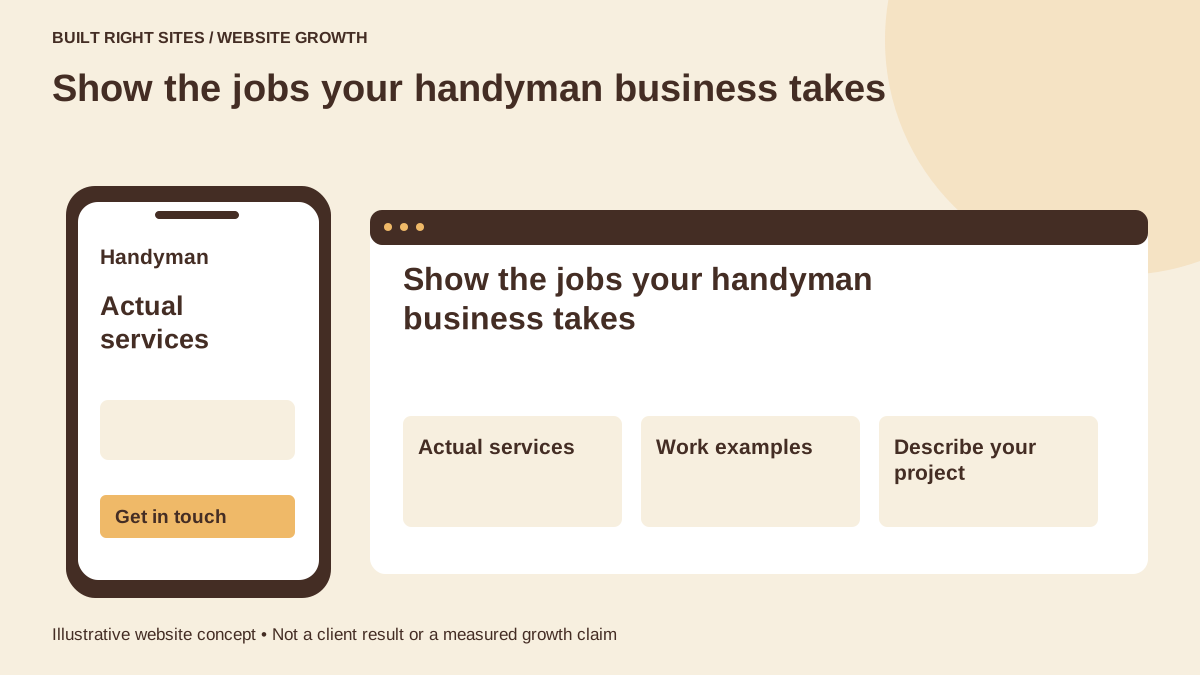
Why “we do everything” can work against you
Many handyman owners try to sound flexible by listing every service under the sun. The problem is that a vague message makes it hard for a homeowner to tell whether you handle small repairs, light carpentry, fixture swaps, or the kind of work that fits your schedule and skill set. A website that clearly names your real services helps people self-select before they ever call.
In this business, clarity is not about shrinking what you do. It is about making your day simpler. When a homeowner understands that you handle patching drywall, replacing trim, and fixing doors, but not full remodels, the site filters out mismatched requests and gives better-fit jobs a cleaner path to contact you.
What a better first impression looks like
Imagine a homeowner searching late at night for help with a sticky bathroom door, a loose handrail, and a few drywall holes from a recent move. If your site opens with a broad slogan and no specifics, they may leave guessing. If it opens with a clear statement of the jobs you take, plus photos or examples of completed work, they can quickly decide whether you are the right fit.
A stronger homepage usually answers three questions fast: what you do, where you work, and what kinds of jobs you prefer. Clear business details help establish identity. That simple clarity can matter as much as design, because it helps a local visitor understand that you are a real neighborhood service business, not a generic listing with no focus.
Explore websites for handyman businesses for an example of how this can work on a site.
The service list should match the jobs you want more of
One of the best ways to grow a handyman business with a more focused website is to write for the work you want to repeat. If your ideal jobs are fence repairs, faucet swaps, shelving, door adjustments, and minor exterior fixes, say so plainly. If you do not want full kitchen or bath remodels, say that too in a polite, professional way.
That does not mean stuffing every page with technical language. It means making your site useful to a homeowner who is comparing options. A brief service page with plain-English descriptions, a few before-and-after photos, and a short note about the types of projects you usually handle can do more than a generic “all jobs welcome” message. It sets expectations before the first call.
For the next part of this process, read Choose one page or a fuller website.
How local search and simple discovery fit in
A focused site can also help with local discovery because people often search by problem, not by business name. Someone may type “replace attic ladder” or “fix porch railing” before they ever think about hiring a handyman. If your website clearly mentions those services in natural language, it can help search engines understand what your business is about without turning the page into a keyword pile.
That is where SEO fits in for this kind of business: make the site easier to understand, then keep the content honest and specific. The search side is not magic, and it is not a guarantee of calls. But a page that plainly describes your work can be easier for nearby homeowners to find than one that only says you are available for anything and everything.
A simple before-and-after website example
Before: “Local handyman for all your home needs.” That sounds broad, but it leaves the visitor wondering whether you are the right person for a small repair, a punch list, or a larger project. After: “Handyman help for drywall repair, trim work, door adjustments, and small home fixes.” The second version is narrower, but it is also more convincing because it matches the kind of work the homeowner is actually trying to solve.
A hypothetical buyer journey makes the difference easy to see. A homeowner lands on your site after realizing they need help with three small issues, not a remodel. They see the services, a few work examples, and a short contact prompt. Instead of hunting through a vague homepage, they can move from question to action in one visit. That is the real value of focus: less confusion, more qualified conversations, and fewer mismatched leads.
If you want your handyman website to support growth, start by making it clear what you do best and what you do not. A site built around the jobs you want more of can improve trust, reduce bad-fit inquiries, and make local discovery easier for the right homeowners, while staying realistic about what a website can and cannot do on its own.
Related articles
See how your next website could work
A clear site gives interested customers a useful next step. Explore a homepage for your business, then decide whether it fits.
See my free homepageSources and further reading
- Google: Business details — Clear business details help establish identity.
Sources checked October 18, 2026. The examples and practical recommendations are our editorial guidance. AI-assisted drafting; reviewed before publication.