What customers are really trying to figure out
Many people searching for a mobile mechanic are not shopping for a brand; they are trying to solve a specific car problem quickly and want to know whether you can come to them. A good website answers the basics up front: what repairs you handle, what kinds of vehicles you work on, and which towns or neighborhoods you regularly serve.
That matters because “mobile mechanic” can mean different things to different customers. One person may need a brake inspection in a driveway, while another expects roadside help after a breakdown. If your site clearly says what you do and what you do not do, you reduce the chance of mismatched calls and make it easier for customers to decide whether to reach out.
Why service area details matter more than vague promises
A local website should make your travel area easy to understand. Not every mobile mechanic covers the same distance, and not every job makes sense in every location. Listing the cities, suburbs, or parts of town you regularly serve helps visitors decide whether you are a realistic option before they call.
This also keeps the conversation honest. If you handle scheduled maintenance, starter issues, battery replacements, or brake work, say so plainly. If a customer needs towing, roadside rescue, or a repair that requires a full shop lift, it is better that they know your limits before they waste time guessing. Clear service-area language can save everyone from a frustrating back-and-forth.
Explore websites for mobile mechanic businesses for an example of how this can work on a site.
A search journey that starts with a problem
Imagine a driver whose car will not start outside their apartment complex on a Monday morning. They search for help, land on your homepage, and immediately see that you come to their neighborhood, handle battery and starter checks, and ask for a short description of the issue before scheduling. Instead of a long, generic pitch, the page gives them a simple path forward.
Now compare that to a site that only says “fast, reliable service.” The visitor still does not know whether you travel to them, what repairs you take on, or what details to send first. A stronger website can turn that uncertainty into a useful next step. The goal is not to promise a fix online; it is to help the customer make a better first contact.
For the next part of this process, read Help local plumbing customers find you.
How SEO fits without overpromising
For local search, the basics are about being understandable to both people and search engines. A few clear pages, accurate location details, and service descriptions can help your site get discovered. As Google notes, sitemaps aid discovery, without assuring indexing. That is useful to know, because discovery is only one part of the picture.
SEO is not a magic switch, and a website does not create demand by itself. It works best when your pages match the questions local customers actually ask, such as whether you come to their area and what kind of repair request they should submit. The practical win is clarity: when your site says the same thing a customer is thinking, it is easier for them to contact you with the right expectations.
A homepage concept that matches the way you work
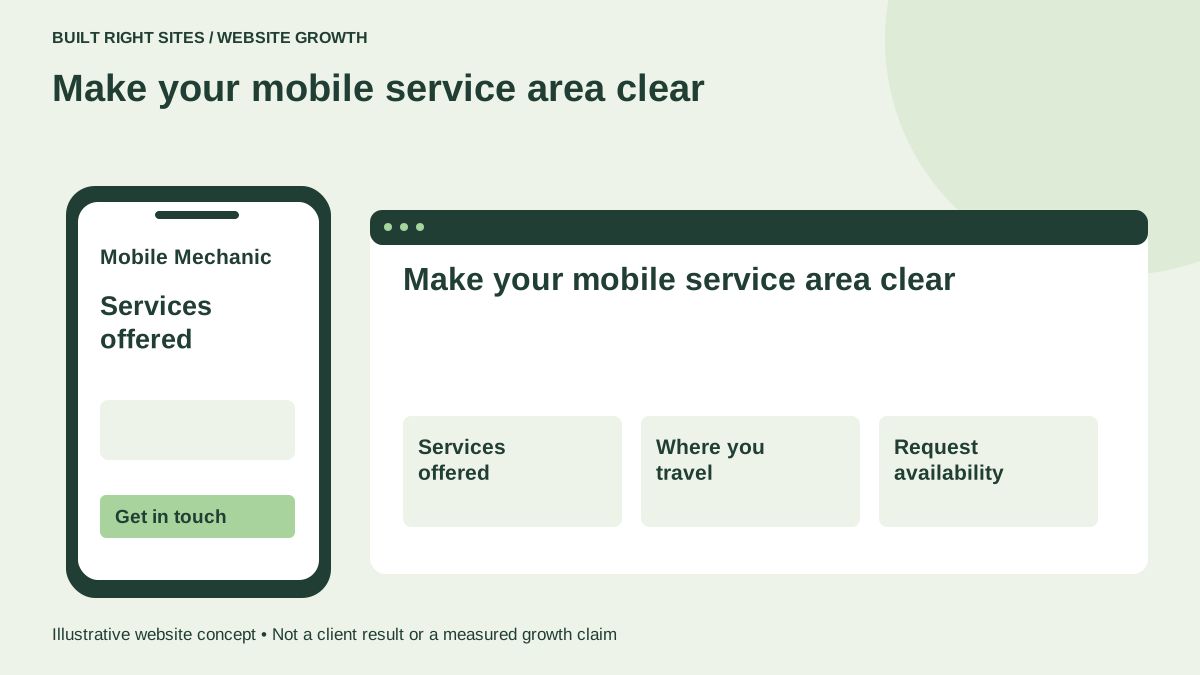
A strong homepage for a mobile mechanic does not need to be complicated. It can open with a plain statement of who you serve, followed by the types of repairs you handle, the areas you travel to, and a simple request form or call prompt that asks for the vehicle problem, location, and timing. That structure supports the buyer journey without forcing visitors to hunt for basic facts.
Hypothetically, a visitor might read: “Mobile repairs for drivers in North Austin, with service for batteries, brakes, and starter issues. Send your location and a short description of the problem to check availability.” That wording is specific, realistic, and helpful. If you are considering a website that reflects your services clearly, a simple homepage concept can show how that message might look before you decide to pay.
A mobile mechanic website works best when it helps nearby drivers understand your service area, your repair scope, and the kind of request you want them to send. That kind of clarity can improve the quality of inquiries, even though it cannot guarantee results.
Related articles
See how your next website could work
A clear site gives interested customers a useful next step. Explore a homepage for your business, then decide whether it fits.
See my free homepageSources and further reading
- Google: Sitemaps — Sitemaps aid discovery, not guaranteed indexing.
Sources checked October 18, 2026. The examples and practical recommendations are our editorial guidance. AI-assisted drafting; reviewed before publication.