A homeowner’s search usually starts with a place name
Imagine a homeowner in a nearby suburb searching late at night after spotting a ceiling stain. They are not looking for a roofing company in the abstract. They are trying to answer one practical question: who serves my area and can I trust them to come out for a repair or replacement? A service-area page gives that person a clearer next step than a homepage that only says “serving the region.”
For a roofing business, that page works best when it names the town, nearby neighborhoods, and the kind of work you actually take on there. The point is not to stuff city names across the page. It is to make it obvious that your company has real coverage in that area and a relevant reason to be contacted.
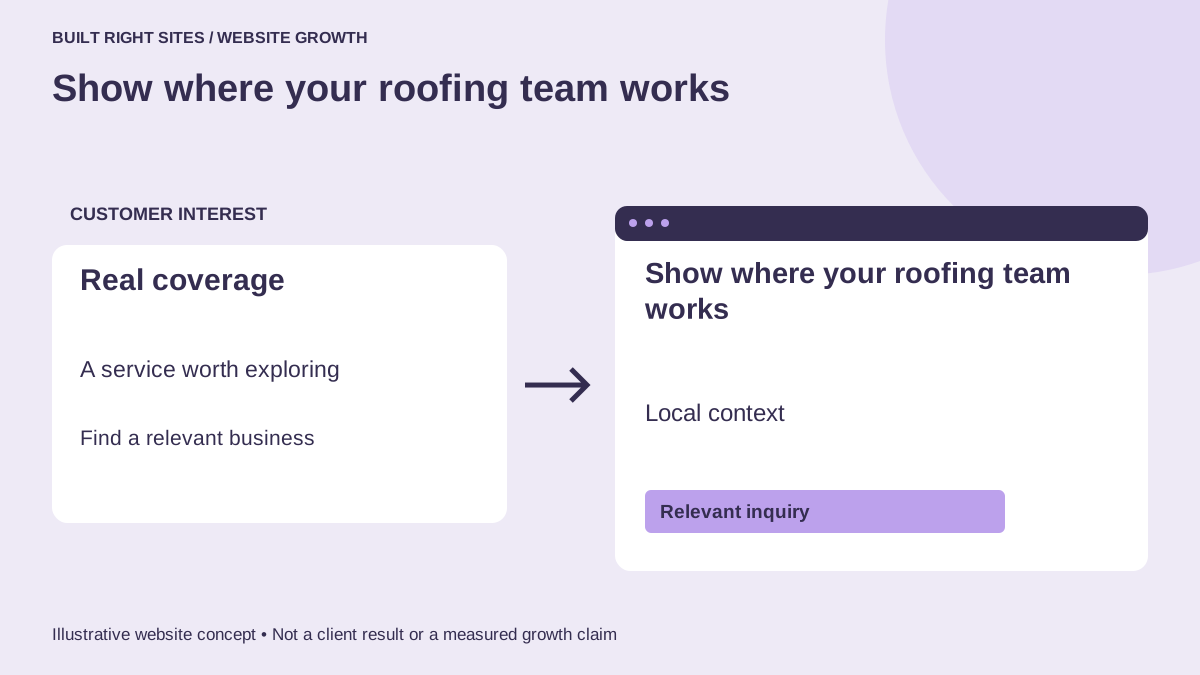
Real coverage beats a copied city template
A common mistake is creating ten nearly identical pages with different city names swapped in. Those pages may look active, but they do not help a homeowner decide anything. They also do not give your website much credibility when the wording is the same everywhere except the location term. Better local pages are grounded in real service patterns, nearby landmarks, roof types common in the area, or the kinds of properties you actually see there.
If your crew regularly works in one suburb with older homes, that page can mention the typical roof materials, common repair questions, and how you handle inspections in tight residential streets. If another area is mostly newer subdivisions, the page can reflect that reality. The page should read like it was written by a roofing business that knows the area, not a template trying to pretend it knows it.
Explore websites for roofing businesses for an example of how this can work on a site.
What a useful page can help a lead decide
Think about the before-and-after difference in a hypothetical buyer journey. Before: the homeowner finds your website, sees a generic service list, and leaves uncertain whether you even work in their town. After: they land on a page for their area, see the local service note, recognize the kind of roofing issue they have, and click to ask for an estimate or inspection. That shift does not guarantee a lead, but it can reduce hesitation.
The page can also answer small but important questions that often slow roofing inquiries. Do you handle emergency tarp work in that area? Do you work on steep-slope roofs, asphalt shingles, or metal roofing? Is the neighborhood within your normal service range? Those details matter because many roofing leads fail at the “am I even in the right place?” stage.
For the next part of this process, read Help roofing searchers become customers.
SEO helps discovery, but only when the page is genuinely useful
For search discovery, the basic idea is simple: local pages can help search engines understand where you work when the content is specific and not stuffed with repeated phrases. Avoid manipulative pages and keyword stuffing. That matters because a page built only to chase search terms can look thin to both people and search systems.
Still, service-area pages are not magic. They do not replace good reputation, clear contact options, or strong project descriptions. A homeowner may find the page through search, but they will only act if the page feels real, explains the service clearly, and makes it easy to ask for help. The website supports discovery; the business still has to earn the inquiry.
A better website structure for a roofing company grows with the business
If you are deciding whether to rebuild your site, think about how someone would move from “I need a roofer” to “this company works in my area and handles my kind of roof.” A strong structure might start with a homepage, then branch into service pages and a small number of local pages tied to places you actually cover. That keeps the site easier to navigate than a giant directory of copied locations.
This is also where a homepage concept can help before you pay for a full build. You can see whether the site reflects your roofing services, your service area, and the kind of local inquiry you want more often. Built Right Sites offers a homepage preview so you can judge whether the direction fits your roofing business before deciding to pay.
Roofing service-area pages can bring better local leads when they are honest, specific, and written for homeowners deciding whether you really serve their town. They work best as part of a clear website, not as copied city pages meant only to fill space.
Related articles
See how your next website could work
A clear site gives interested customers a useful next step. Explore a homepage for your business, then decide whether it fits.
See my free homepageSources and further reading
- Google: Spam policies — Avoid manipulative pages and keyword stuffing.
Sources checked October 18, 2026. The examples and practical recommendations are our editorial guidance. AI-assisted drafting; reviewed before publication.