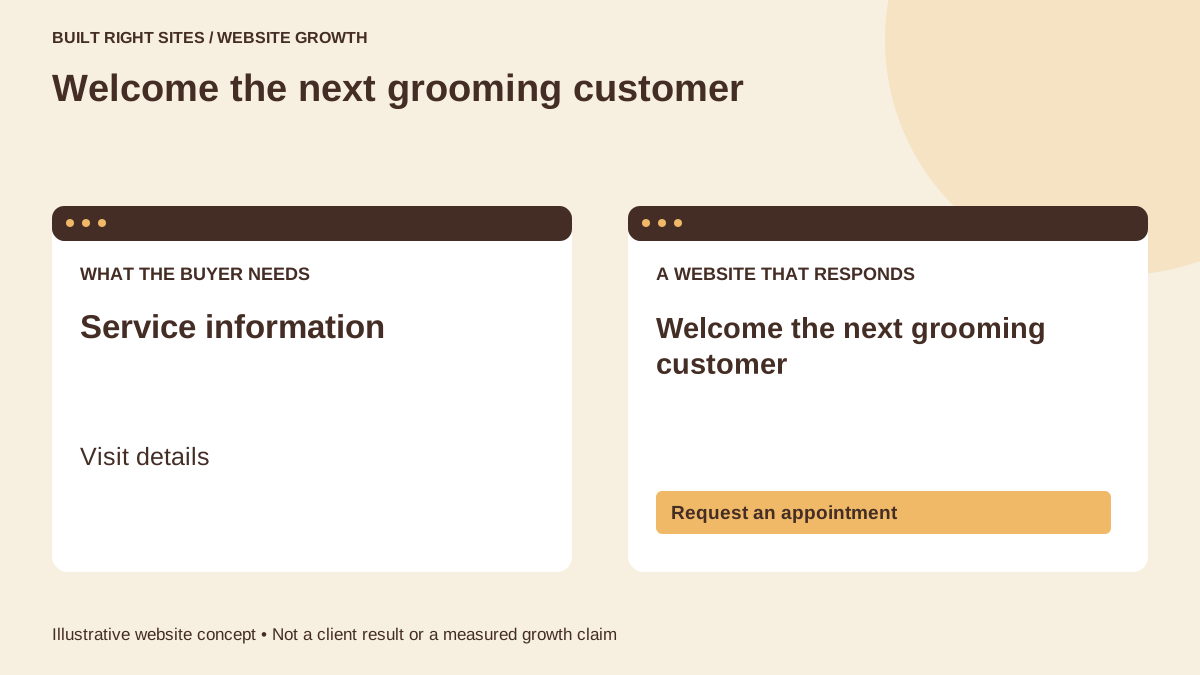
What a first-time visitor is actually looking for
A new customer usually arrives with a short list of practical questions, not a deep knowledge of grooming services. They want to know what kinds of pets you take, whether you’re close enough to be convenient, what the appointment request process looks like, and whether there are any rules they should read before they book. If the website answers those questions quickly, it becomes easier for that visitor to move from browsing to requesting a spot.
That does not mean the site needs to be packed with every detail. It means the important information should be easy to find without guessing. A clear service summary, a visible location or service area, and a simple explanation of how requests are reviewed can save both the groomer and the customer from back-and-forth messages.
A better homepage conversation
Think about a hypothetical visitor named Jenna. She just adopted a medium-size dog, searches on her phone after work, and lands on a grooming homepage. If the page opens with cute photos only, she may admire them and still leave. If the homepage also says what pets you groom, how local requests work, and where to start, she can decide whether to keep going.
A strong homepage can sound friendly without sounding vague. For example, a message like: New to grooming? Start with your pet’s breed, size, and preferred date, then we’ll review your request and confirm availability. That kind of wording helps set expectations. It tells the customer that a request is not yet a confirmed slot, which is important because many grooming businesses need time to check timing, coat condition, and schedule fit.
Explore websites for pet grooming businesses for an example of how this can work on a site.
Why policies should be plain, not buried
Many appointment requests stall because the visitor cannot tell what happens next. If your policies are hidden in a footer or written in stiff language, the customer may hesitate. A clearer site can explain deposit rules, late arrival policies, vaccination requirements if applicable, cancellation steps, and whether walk-ins are accepted or not. None of that has to feel unfriendly; it just has to be understandable.
The goal is not to scare people away. It is to make the request process feel predictable. When a first-time pet owner can read the rules before they submit a form, they are less likely to send an incomplete request or call with avoidable questions. In a service business where timing matters, that clarity can make the website work harder than a social post alone.
For the next part of this process, read Get better custom bakery order requests.
Where search discovery fits, and where it stops
For many local businesses, search visibility helps the right people find the site in the first place. Google Search Console reports search visibility. That means you can see how your pages appear in search, but it does not turn a weak website into a useful one on its own. If the site does not explain services, location, and request steps clearly, more visibility will not fix the confusion.
Search discovery is best treated as the front door, not the whole customer journey. A person might search for a nearby groomer, land on your page, and still need a clear explanation of breeds served, coat types handled, and how requests are reviewed. The site should support that moment. It should not promise more than it can deliver, and it should not imply that every visitor is ready to book immediately.
The difference between cute and request-ready
A common misconception is that a grooming website succeeds because it looks polished. In reality, a pretty site can still fail if it does not help visitors make a decision. Pictures matter, but they should support the business details, not replace them. The better question is: can a new customer understand your service, trust the process, and know how to ask for a time in under a minute or two?
Here is a hypothetical before-and-after example. Before: a homepage with a gallery, a contact button, and no explanation of what happens after submission. After: a homepage that says who you serve, what information to include, and that submitting a request means your team will review availability before confirming. That change does not guarantee more appointments, but it can reduce uncertainty. For an owner considering a website that reflects their services clearly, that may be the most practical improvement of all, especially when exploring a homepage concept before deciding to pay.
A pet grooming website helps most when it answers the questions first-time customers are already asking: is this the right fit, how do I request a time, and what happens next? If the site makes those steps obvious, it can turn more visits into appointment requests without overpromising what the business can take on.
Related articles
- Get better custom bakery order requests
- The Website plan is $399 one time, with no required monthly fee: up to 6 service pages, 10 service-area pages and 2 website tools. Hosting is optional at $9/month, or take the finished files and arrange your own hosting. AI tools are an optional, separately quoted add-on. Website + Marketing is $699/month, with no separate setup fee: hosting, every tool for your trade including AI tools, call tracking, ongoing SEO and Google Business Profile optimization, and two blog posts a month. Choose an optional ad budget separately; it is not part of the $699 fee. Compare both plans and their scope.
See how your next website could work
A clear site gives interested customers a useful next step. Explore a homepage for your business, then decide whether it fits.
See my free homepageSources and further reading
- Google: Search Console — Search Console reports search visibility.
Sources checked October 18, 2026. The examples and practical recommendations are our editorial guidance. AI-assisted drafting; reviewed before publication.