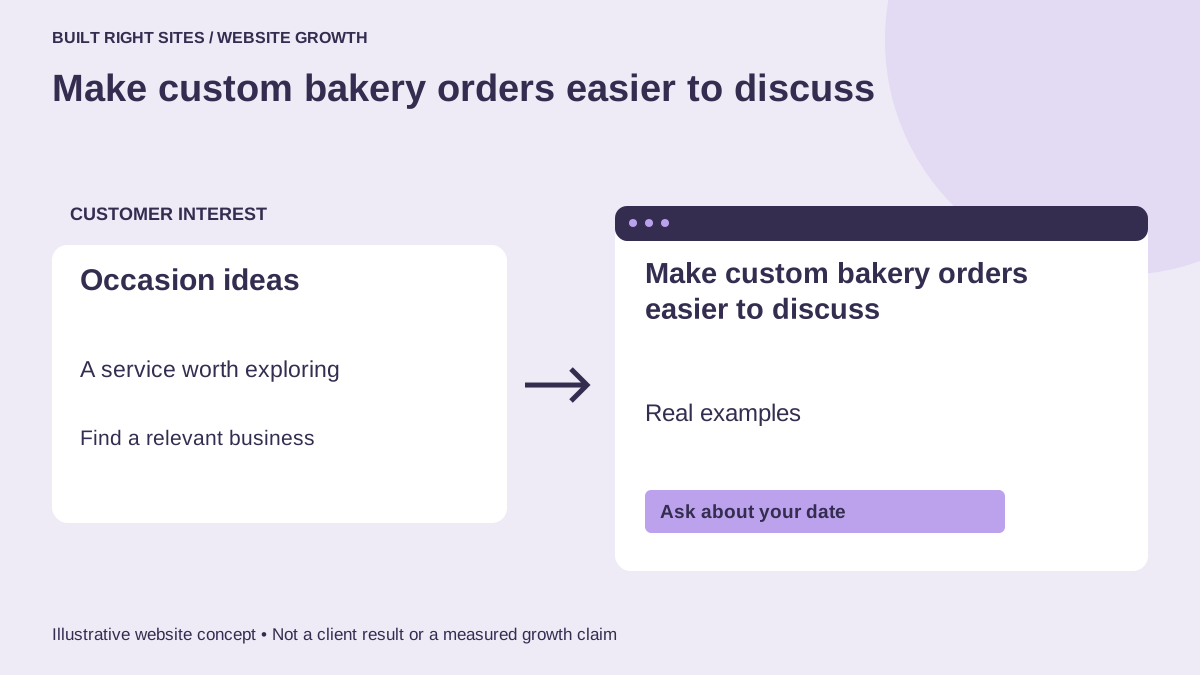
Why walk-in menus and custom orders need different paths
A walk-in menu works when someone already knows what they want to buy today. Custom orders are different. People planning a birthday cake, shower dessert table, or office breakfast usually need reassurance first: what you make, what it might look like, and whether their date is still open.
That is why the website should separate quick browsing from inquiry. A visitor who only wants cupcakes can scan the menu, while someone with an event can find a custom-order path that asks for the occasion, serving size, and date without making them guess where to click.
What a useful custom-order page should answer fast
The best custom-order pages do not try to tell every bakery story at once. They answer the questions that usually slow a customer down: What kinds of events do you handle? What examples can I look at? How do I share my date and details? When those answers are visible, the buyer is less likely to call, leave, and forget to follow up.
A strong page can include real photos of past work, short labels like birthday, wedding, corporate, or holiday, and a simple note inviting people to ask about availability. It helps when the page sounds human rather than formal, because many custom-order buyers want to feel comfortable starting a conversation before they commit to anything.
Explore websites for bakery businesses for an example of how this can work on a site.
A hypothetical buyer journey from browsing to inquiry
Hypothetically, imagine a parent searching for a dinosaur birthday cake on a Tuesday night. They land on your homepage, see today’s pastries, and almost leave because they do not need a box of cookies. Then they notice a clear custom-order link, click through, and find photos of themed cakes plus a short form that asks for the celebration date and guest count.
Before the website, that parent might have called the shop during a busy morning and never reached anyone. After the website, they can send the details when it is convenient, and your team can respond with whether the date is open and what kind of design discussion makes sense. That is not a guarantee of an order, but it makes the first conversation much easier to start.
For the next part of this process, read Help trade show buyers find you.
Where search discovery fits, and where it does not
Search can help when people look for local phrases tied to events, like custom birthday cakes near me or business catering bakery. A bakery website that clearly describes its services, locations served, and order types gives those search visitors a better place to land than a generic homepage. To be careful with expectations: search can support discovery, but it does not create demand by itself.
Google says to avoid manipulative pages and keyword stuffing. That means the site should read naturally, with useful service descriptions and real examples instead of stuffing every page with the same phrase. If a visitor cannot quickly tell whether you handle their event type, the page may be too vague; if it repeats the same words too often, it can feel untrustworthy.
A homepage that fits the bakery you actually run
If your storefront depends on walk-ins, the website can still support that without turning into an online store. Show your case-ready menu, but make the custom side distinct: a gallery, a short explanation of how inquiries work, and a clear cue to ask about dates. That way, one site serves both impulse buyers and event planners without forcing either group through the wrong path.
For an owner comparing options, the question is not whether the website can do everything. It is whether it reflects the way you actually take orders and helps the right person start the right conversation. Built Right Sites offers a homepage concept before you decide to pay, which can help you picture a website that reflects your bakery services without overcomplicating the process.
For bakeries that want more custom inquiries, the website should make event planning feel simple, visible, and personal. If someone can see examples, check the order path, and share their date without friction, the site has done an important part of the job.
Related articles
See how your next website could work
A clear site gives interested customers a useful next step. Explore a homepage for your business, then decide whether it fits.
See my free homepageSources and further reading
- Google: Spam policies — Avoid manipulative pages and keyword stuffing.
Sources checked October 18, 2026. The examples and practical recommendations are our editorial guidance. AI-assisted drafting; reviewed before publication.