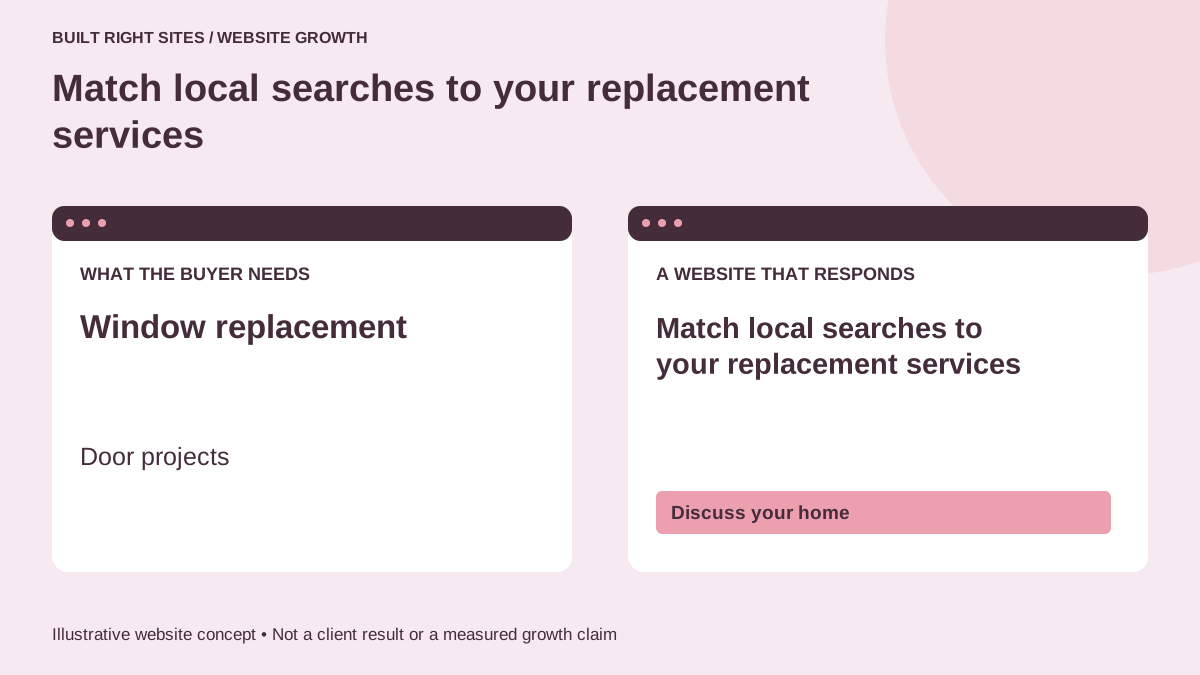
Start with replacement intent, not a big catalog
A homeowner searching for new windows usually has a different goal than someone looking for a quick repair. Your website should make that difference obvious right away. If your main work is replacement, say so on the homepage and give visitors a clear path to the services you actually provide. That helps avoid the common problem of attracting visitors who want a service you do not offer.
For example, a page focused on replacement can speak directly to a homeowner who wants to update an aging front door, compare styles, and understand what happens next. A broad catalog page may look complete, but it can bury the one service that matters most. A focused site gives searchers fewer reasons to leave because they can quickly tell whether your company handles their type of project.
Make local scope easy to understand
Local search only helps if people can tell where you work. A window and door company website should name the towns, neighborhoods, or nearby cities you actually serve instead of leaving geography vague. That way, a person searching from a specific area can recognize themselves in the page copy and decide whether to reach out.
This is also where a website can support discovery without overpromising. Google indexes the mobile version of content. That means your location details, service descriptions, and contact options need to be easy to read on a phone, because many homeowners will first find you from a mobile search and decide quickly whether your company looks like a fit.
Explore websites for windows doors businesses for an example of how this can work on a site.
Build pages around the questions buyers ask
Many replacement buyers are not looking for a brand story first. They want to know what kind of project you take on, whether you handle front doors or full window replacement, and how the process usually begins. A website can answer those questions in plain language without turning into a sales pitch. That is especially useful when your leads come from people comparing several local companies at once.
A practical example: one homeowner searches for a front door replacement after noticing drafts and visible wear. On your site, they find a dedicated service page, a short explanation of the service area, and a contact form that asks for project details. Another visitor searching for a repair may realize you focus on replacement and move on. That is not a failure; it is a sign the site is matching the right audience sooner.
For the next part of this process, read Turn flooring browsing into showroom visits.
Use search terms that match actual jobs
Search visibility is usually strongest when your pages reflect the work homeowners actually request. Instead of writing a page that tries to cover every possible home exterior topic, use your site to separate window replacement, door projects, and other specific services into pages with clear titles and plain descriptions. That helps your content line up with the way people describe their own projects.
A common misconception is that one homepage can do all the work. In practice, a homeowner searching for replacement services wants specifics, not a general overview. You do not need to chase every variation of a keyword to be useful. You do need to make it obvious that the page is about the exact kind of service the visitor wants, in the places you serve.
Know what a website can do, and what it cannot
A better website can make your business easier to understand, easier to contact, and easier to find for local searches tied to replacement intent. It can also reduce confusion between repair and replacement buyers, which matters because those leads often need different conversations. But a website is not a guarantee that every visitor will call, and it will not create interest where there is none.
Hypothetical before-and-after wording can show the difference. Before: “We handle windows, doors, and more.” After: “We help homeowners in our area with window replacement and front door replacement projects.” The second version is narrower, but that is the point. It tells the right visitor what you do and gives the wrong visitor a quick answer. If you are considering a website that reflects your services and the area you cover, that clarity is exactly where the value starts.
For a window and door company, a useful website is less about looking busy and more about matching the searcher’s intent with the right service and location details. When the copy is specific, homeowners can tell faster whether you are the right fit, and that can make local search inquiries more meaningful.
Related articles
See how your next website could work
A clear site gives interested customers a useful next step. Explore a homepage for your business, then decide whether it fits.
See my free homepageSources and further reading
- Google: Mobile-first indexing — Google indexes the mobile version of content.
Sources checked October 18, 2026. The examples and practical recommendations are our editorial guidance. AI-assisted drafting; reviewed before publication.