Start with the service decision, not the page design
The main question is not which service sounds nicest. It is which service should get the first position on the homepage because it best fits your business direction and the jobs you want to handle next.
A useful homepage focus is a business decision first and a writing decision second. If the message does not match how you actually work, the site can create confusion for visitors and for your own team when they answer calls, emails, or quote requests.
Use the four-part matrix to narrow the choice
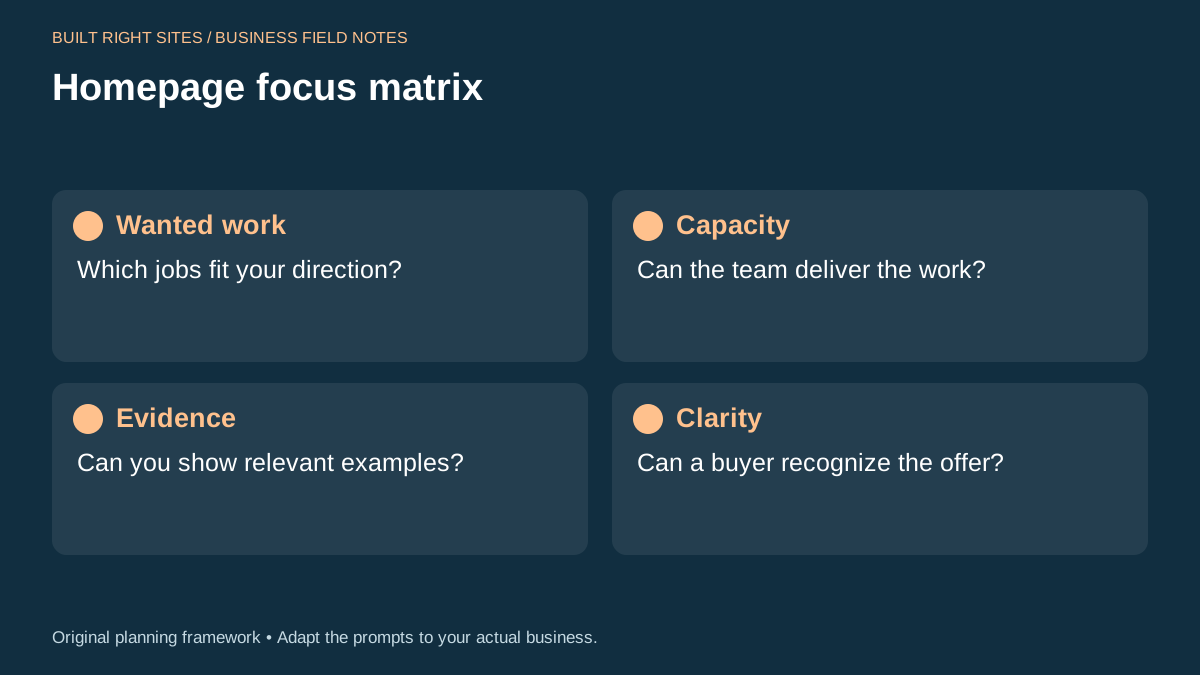
The printable worksheet organizes the decision around four questions: wanted work, capacity, evidence, and clarity. Those four pieces are enough to make a practical choice without guessing based on what sounds broadest.
Wanted work asks which jobs fit where you want the business to go. Capacity asks whether your team can deliver that work consistently. Evidence asks whether you have examples, photos, or descriptions that support the claim. Clarity asks whether a buyer can recognize the offer quickly.
This is where many small businesses get stuck. A service may be profitable, familiar, or common in your area, but if it does not fit your direction, stretches your schedule, or lacks proof, it may not be the best homepage lead.
See example business websites with clear services and contact paths for an example of how this can work on a site.
A worked example for a landscaper choosing between mowing and installation
Imagine a landscaper who offers recurring mowing and landscape installation. The owner wants the homepage to feature one service first, because both lines of work are active but they do not serve the business in the same way.
Using the matrix, the owner writes this: Wanted work — installation fits the direction because the company wants more design-build jobs; mowing stays important but is less central on the homepage. Capacity — the crew can handle installation projects without overpromising, but recurring mowing is already well organized and does not need the homepage lead slot. Evidence — there are strong before-and-after photos and completed project examples for installation. Clarity — buyers can recognize “landscape installation” as a project-based offer, while “mowing” is more of a routine service and may be easier to explain elsewhere.
The final homepage choice in this example is landscape installation as the featured service. The owner can still mention mowing on the page, but the main headline, first call to action, and opening section focus on installation. That keeps the message aligned with the direction of the business and the proof the company can actually show.
A sample homepage line could read: “Landscape installation for yards that need a fresh layout, new plantings, and a clean finish.” That wording is plain, specific, and easy to connect to photos and service details.
For the next part of this process, read Research competitors without copying them.
Turn the decision into a homepage that supports operations
Once you choose the featured service, the homepage should help people take the next step without extra friction. That means the service name, headline, supporting text, and contact path should all point to the same offer.
Do not bury the featured service under broad language like “quality solutions for every property need.” Use direct wording that matches what you actually sell. Then make the next step easy: request a quote, ask a question, or review related service details.
Also make sure your internal process is ready. If the homepage sends more requests for the featured service, the person answering those leads should know what information to collect, what questions to ask, and when to route a prospect to a different service. The website should support the business flow, not create extra sorting work.
Put this into practice
Homepage focus matrix
- Wanted work: Which jobs fit your direction?
- Capacity: Can the team deliver the work?
- Evidence: Can you show relevant examples?
- Clarity: Can a buyer recognize the offer?
An original planning framework from Built Right Sites, not a validated benchmark.
Keep secondary services visible without weakening the main message
A homepage does not have to hide the rest of what you do. It just needs a clear lead. Secondary services can still appear in a short list, a supporting section, or a link to a dedicated page.
The key is contrast. If every service gets equal weight, the visitor has to figure out what matters most. If one service leads and the others support it, the page is easier to read and your offer is easier to remember.
This approach works best when your homepage lead is the service that fits your direction, your capacity, your evidence, and the way customers describe the need. That is a practical decision, not a branding exercise. It helps the site reflect how the business actually operates and what the team is ready to sell next.
If you are deciding which service deserves your homepage spotlight, choose the one that best fits your wanted work, your capacity, your proof, and the way buyers can understand the offer. Then make the homepage, intake process, and service pages support that choice together. That is the practical way to turn a website decision into a clearer business decision.
Related articles
See how your next website could work
A clear site gives interested customers a useful next step. Explore a homepage for your business, then decide whether it fits.
See my free homepageSources and further reading
- SBA: Market research and competitive analysis — Customer interviews and competitor research can inform positioning.
Sources checked October 18, 2026. The worksheets and practical recommendations are our editorial guidance. AI-assisted drafting; reviewed before publication.