Start with public facts, not guesses
When you research competing websites, begin only with what a visitor can actually see. Record the services named on the page, the industries mentioned, the locations served, the contact options, and any obvious calls to action. This keeps you from building strategy around assumptions that are not supported by the page itself.
The basic question is simple: what does this business say it does, and what information does it make easy to find? That is enough to begin a useful comparison without scraping accounts, digging into private systems, or drawing conclusions about how well the business performs.
Compare what is promised with what is actually explained
A useful comparison is not about style. It is about clarity. Many sites promise fast service, high quality, or local expertise, but those words do not tell a buyer how the work happens, what is included, or how to choose the right service. Your job is to notice the gap between visible promise and visible explanation.
For a small business owner, that gap often shows up in practical places: no service boundaries, no examples of typical jobs, no explanation of what happens after the first call, and no easy path for a customer to ask a specific question. If you can identify those gaps on competitor sites, you can build pages that answer them in plain language. That is a stronger use of research than copying the same headline or layout.
If a competitor lists “residential and commercial cleaning,” for example, that tells you the market segment but not the operating difference. Does it mean nightly janitorial work, one-time deep cleans, or recurring house cleaning? A visitor may not know. Your site can be better if it spells that out instead of assuming the label is enough.
See example business websites with clear services and contact paths for an example of how this can work on a site.
Turn research into your own useful site copy
Once you see the gaps, write for the buyer, not against the competitor. The best response is usually a clearer service explanation, a sharper FAQ, or a more direct contact path. You do not need to mention the competitor at all. You only need to explain your own offer in a way that helps a prospect decide what to do next.
Keep the copy grounded in real operations. If you serve a local area, say what that means in practical terms. If you require a walkthrough, name it. If certain jobs are better handled by phone than by form, say so. This kind of detail is useful because it reduces back-and-forth and helps the buyer know whether they are in the right place.
Here is a hypothetical example. Suppose a local cleaning company reviews three competitor websites and notices that all three say “professional cleaning services,” but none explain how scheduling works for first-time customers. The owner decides the homepage should say: “Tell us the size of the space, the type of cleaning you need, and the best day to reach you. We will follow up with the next step.” That wording does not copy anyone else, and it gives the visitor a concrete path forward.
For the next part of this process, read Choose your homepage’s featured service.
Use the results to improve operations, not just design
Website research should point to real operational choices. If buyers keep asking the same question, your site may need a better answer, but your intake process may also need a better script. If people cannot tell what you handle, your service list may need tightening. If they keep bouncing between pages, your navigation may need to match how customers think, not how your team organizes work internally.
This is why competitor research is only one part of the job. Customer interviews, phone calls, and front-line questions can reveal what people actually need to know before they buy. The SBA notes that customer interviews and competitor research can inform positioning. That is a good reminder that public website observation is a starting point, not the whole picture.
A practical next step is to review your own site alongside the notes you took from competitors. Ask which questions you answer more clearly, which ones you avoid, and which ones deserve a new page, a better FAQ, or a simpler contact form. Then align the site with how your business really works so visitors do not have to guess.
Put this into practice
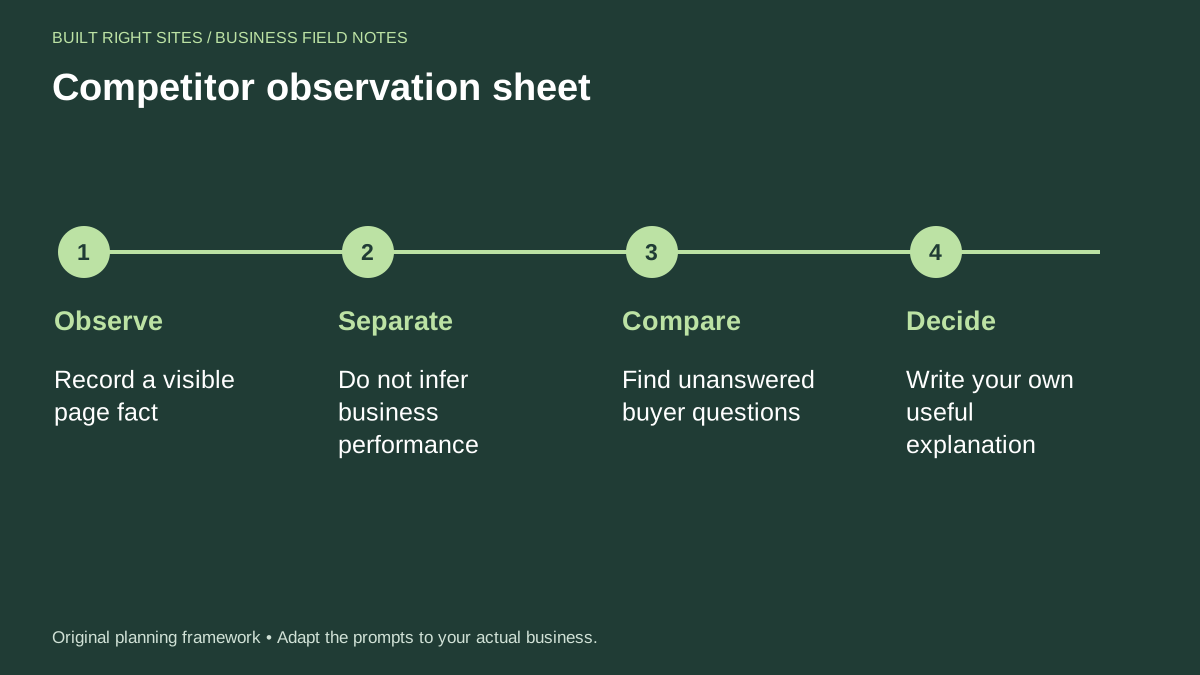
Competitor observation sheet
- Observe: Record a visible page fact
- Separate: Do not infer business performance
- Compare: Find unanswered buyer questions
- Decide: Write your own useful explanation
An original planning framework from Built Right Sites, not a validated benchmark.
Researching competing websites is most useful when it helps you write clearer explanations and make better operating decisions. Look at what is publicly visible, separate claims from proof, notice what buyers still need to know, and then build your own site around those gaps instead of copying the pages that already exist.
Related articles
See how your next website could work
A clear site gives interested customers a useful next step. Explore a homepage for your business, then decide whether it fits.
See my free homepageSources and further reading
- SBA: Market research and competitive analysis — Customer interviews and competitor research can inform positioning.
Sources checked October 18, 2026. The worksheets and practical recommendations are our editorial guidance. AI-assisted drafting; reviewed before publication.