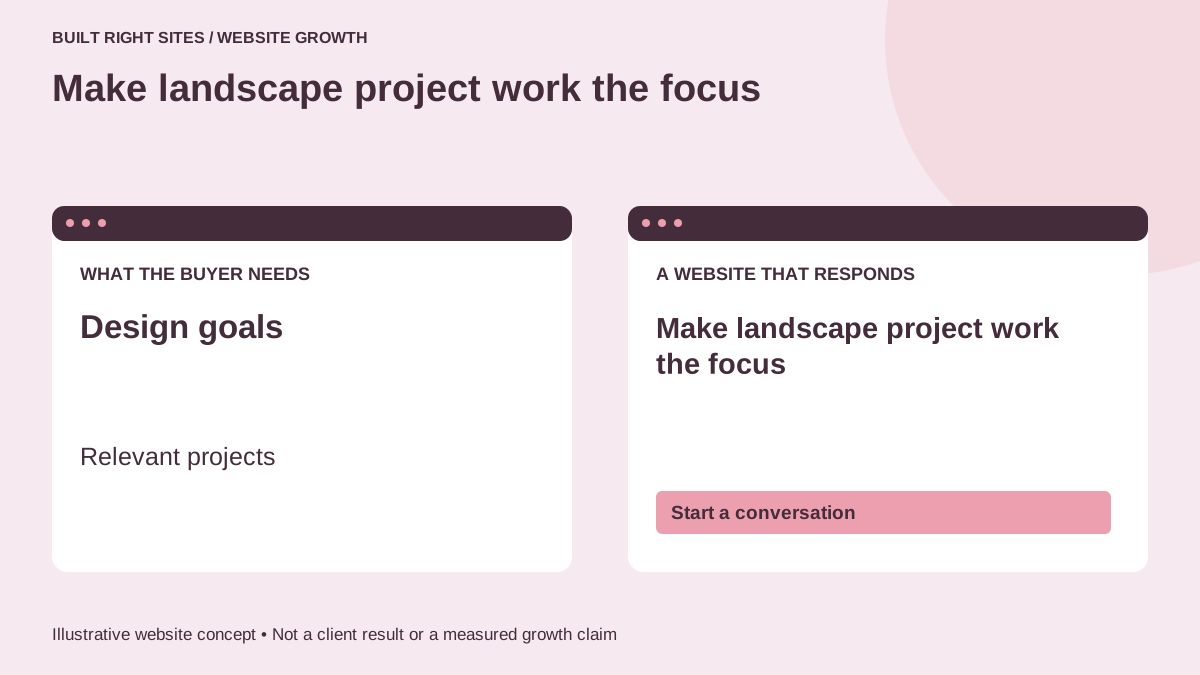
When the website attracts the wrong kind of call
A lot of landscaping websites accidentally invite the wrong inquiry. The homepage talks about “full-service landscaping,” shows a mower, and ends with a generic contact button. That can work for basic maintenance, but it does little to separate a design-focused business from every other crew in town.
A better site starts by naming the work you want more of. If your ideal project is a backyard redesign, patio layout, drainage fix, or planting plan, that should be clear near the top of the page. Clear business details help establish identity, and that matters because visitors need to understand who you are before they decide whether your services fit their project.
What a design-focused homepage should make obvious
The homepage should answer one simple question: “Can this company handle my kind of project?” That means showing design intent in the words and the visuals. Instead of only listing equipment or maintenance tasks, describe the kinds of spaces you plan and build, such as outdoor living areas, front-yard makeovers, or complete property transformations.
A useful homepage also gives a fast path from interest to action. For example, a homeowner landing on your site after searching for help with a new patio should be able to see a relevant project photo, read a short explanation of the design challenge, and know how to ask about a similar job. The goal is not to stuff the page with everything you do; it is to make the right service feel immediately visible.
Explore websites for landscaping businesses for an example of how this can work on a site.
The project story does more than a gallery
Photo galleries are helpful, but they often flatten the story into before-and-after images with no context. For design work, the context is what builds confidence. A visitor wants to know what problem the project solved, what choices were made, and how the finished space fits the property and the owner’s goals.
Hypothetical example: a homeowner searches for a company to redesign a sloped side yard. Your homepage features a short story about a similar project, explaining that the owner wanted better access, more usable space, and plantings that fit the light conditions. That story does not need to be long. It just needs enough detail to help the visitor imagine their own project in your hands. Compare that with a page that simply says, “We do landscaping.” The first version gives a reason to inquire; the second leaves the visitor guessing.
For the next part of this process, read Turn kitchen interest into consultations.
How search discovery fits without overpromising
Search discovery can help people find you when they are already looking for a landscaping redesign, but it is only one part of the picture. If your website uses plain language that matches the kinds of projects people describe, it becomes easier for search engines and visitors to recognize what your business is about.
Use your landscaping website to attract design projects by making service pages and homepage copy reflect design/build intent rather than only routine upkeep. That does not guarantee traffic or leads, but it does make the site more relevant to the searches and questions you actually want. The important limit is that a website cannot create demand on its own; it can only make existing interest easier to notice and respond to.
A better fit when you are deciding whether to rebuild
This is where a website rebuild becomes a business decision, not just a design decision. If your current site looks fine but keeps framing you as a mowing-first company, you may be losing the chance to show what makes your work different. A redesign can correct that mismatch by putting project stories, service descriptions, and contact prompts in the right order.
Hypothetical before-and-after wording example: before, the homepage says, “Weekly lawn care and seasonal cleanup.” After, it says, “Landscape design and build for outdoor spaces that need a new plan.” The second version does not exclude maintenance, but it makes the growth goal clear. If you are thinking about a website that reflects your services more accurately, Built Right Sites builds business websites and can start with a homepage concept before you decide to pay.
A landscaping website works best when it helps the right visitor recognize design capability fast, understand the kind of projects you want, and take a small next step. That shift is practical, not magical, but for a business that wants more design-build inquiries, it can make the difference between a site that blends in and one that supports the work you want more of.
Related articles
See how your next website could work
A clear site gives interested customers a useful next step. Explore a homepage for your business, then decide whether it fits.
See my free homepageSources and further reading
- Google: Business details — Clear business details help establish identity.
Sources checked October 18, 2026. The examples and practical recommendations are our editorial guidance. AI-assisted drafting; reviewed before publication.