Start with the decision the page should support
The goal is not to tell your whole origin story. The goal is to help a visitor decide whether your business fits their need. That means the page should answer the questions a cautious buyer is already asking before they contact you. A good About page reduces uncertainty about the people, the work, and the next step.
For a local service business, a customer usually wants to know whether the company does the kind of job they need, who will handle it, and how communication works. If those details are missing, visitors may leave still unsure. If those details are clear, the page can support the rest of the site instead of competing with it.
Write the body around roles, process, scope, and proof
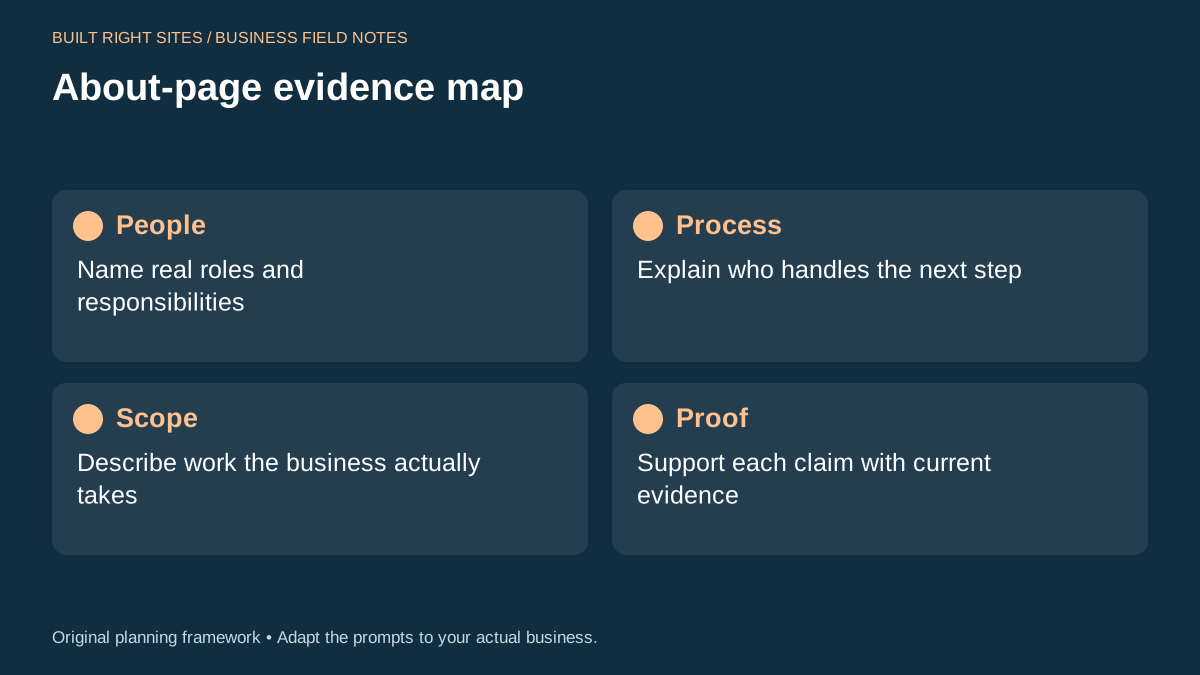
A useful About page usually works best when it moves in a practical order. First, identify who the customer is dealing with. Next, explain how work moves from first contact to the next action. Then describe what jobs you actually take on. Finish with evidence that backs up what you say.
This approach is stronger than generic passion copy because it answers real buying questions. A visitor does not need a speech about why you love your craft. They need to know whether you handle their type of project, who owns the follow-up, and whether your claims have current support. That is what helps a customer choose.
When you write, keep the wording direct and specific. Use job titles, service names, and plain descriptions of responsibility. If you mention a promise or standard, tie it to something concrete the business currently does, such as a written estimate process, a named point of contact, or a published service area.
See example business websites with clear services and contact paths for an example of how this can work on a site.
Replace vague passion copy with specific, verifiable details
Many About pages say the business is passionate, dedicated, or committed, but that does not help a buyer decide. Those words are too broad to compare and too easy to ignore. A stronger page gives details a customer can assess.
Instead of saying you care about quality, describe how quality is handled. Instead of saying you value communication, explain who replies and what the follow-up looks like. Instead of saying you are experienced, state the kinds of work you actually take on and the evidence you can show for that work. Keep the claims narrow enough that they can be checked.
For example, if the business is a two-person local contractor, the page should say who estimates the job, who performs the work, and what types of projects are accepted. That is more useful than a general statement about craft, pride, or family values. The point is not to sound polished. The point is to help the reader understand the working setup.
For the next part of this process, read Answer the questions your customers ask.
Worked example: a solo local service business
Here is a hypothetical example for a solo exterior cleaning business. The old About copy says: “We are passionate about helping homeowners and businesses with quality service and exceptional care.” That sounds friendly, but it does not help a customer choose. It does not say what work is accepted, who answers the phone, or what happens next.
A better version could read: “I’m Jordan, and I handle the estimate, scheduling, and cleaning myself. I take on driveway washing, siding cleaning, and small storefront cleanups. If you contact the business, I review the request, confirm the scope, and send the next step for approval before any work begins.” This version gives a real role, a real process, and a real service scope. It is still simple, but it is useful.
A completed decision for that business might be: remove the broad mission paragraph, add Jordan’s role, add the service list, and add a short line about the estimate and approval step. That gives the reader enough information to decide whether to move forward without making unsupported claims.
Put this into practice
About-page evidence map
- People: Name real roles and responsibilities
- Process: Explain who handles the next step
- Scope: Describe work the business actually takes
- Proof: Support each claim with current evidence
An original planning framework from Built Right Sites, not a validated benchmark.
Make the page work with the rest of the site
An About page should not do every job alone. It works best when it supports the service pages, contact path, and any FAQ or project pages you already have. If a visitor still has questions after reading the About page, the rest of the site should make those answers easy to find.
Structure matters too. Clear headings help readers scan the page and move to the section they need. That is useful on small-business sites where visitors may be comparing several providers. Headings also make the page easier to follow on smaller screens and assist navigation when the content is longer than a short bio.
After drafting, read the page as if you were the customer. Can you tell who owns the next step? Can you tell what work is accepted? Can you see the evidence for the main claims? If not, cut the soft language and replace it with one more concrete detail. The best final version is usually the shortest one that still answers the decision question.
If you want an About page that helps a customer choose, focus on the facts a buyer can use: who does the work, how the next step happens, what service scope you actually accept, and what evidence supports the claims. Keep the page specific, current, and easy to scan, and it will support a real decision instead of just filling space.
Related articles
See how your next website could work
A clear site gives interested customers a useful next step. Explore a homepage for your business, then decide whether it fits.
See my free homepageSources and further reading
- W3C: Headings — Headings communicate content organization and support navigation.
Sources checked October 18, 2026. The worksheets and practical recommendations are our editorial guidance. AI-assisted drafting; reviewed before publication.