Start with the decision: what happens after a missed call?
The first step is not design. It is deciding who handles the call after it is missed. If a caller is asking about a new project, the business should have a path for collecting the service needed, the caller’s name, and the best reply details. If the caller is asking about an existing job, the call should go to the person already responsible for that project.
This decision helps keep the response from becoming a guessing game. A receptionist, owner, or office manager can follow the same rule each time instead of deciding on the fly. That is especially useful when one business handles both new work and active jobs.
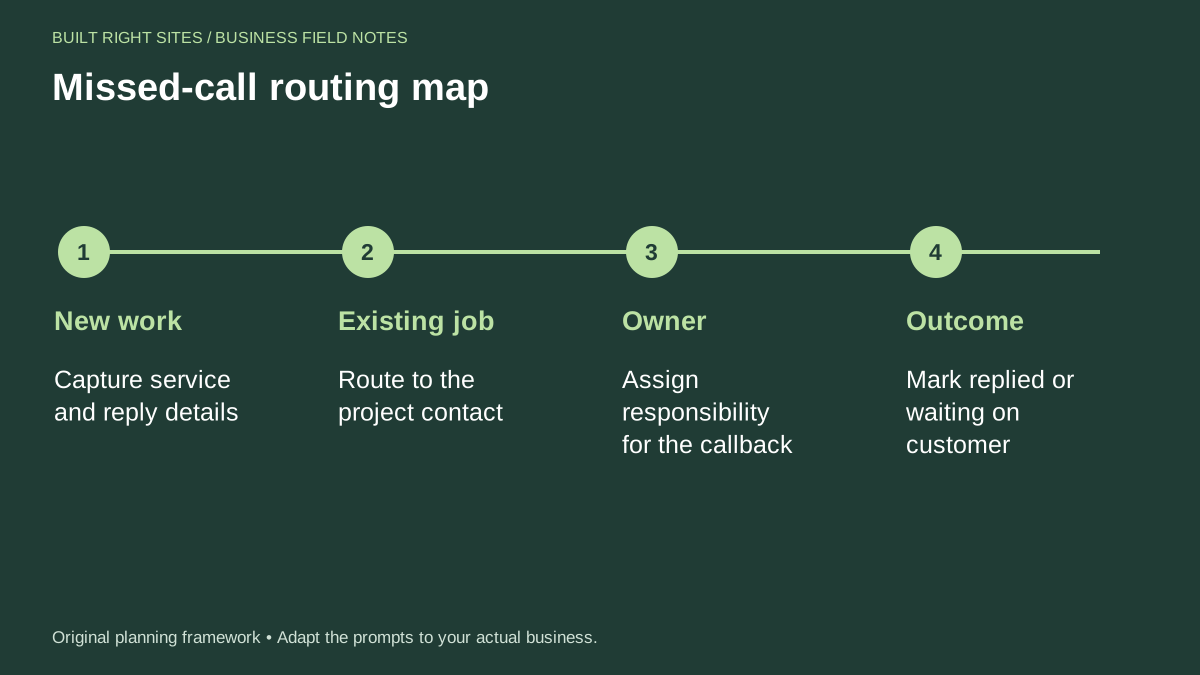
A simple routing rule can prevent confusion: new work goes to intake, existing jobs go to the project contact, and the owner is responsible for making sure the callback happens. Then the business marks the request as replied or waiting on the customer so nobody assumes it was handled when it was not.
Use voicemail and website wording that matches the request
Missed-call instructions should be plain and specific. If the caller might be a new lead, the voicemail should ask for the service needed and the best way to reach them. If the caller may be asking about a current job, it should point them to the person or line that handles project updates.
The website should support the same logic. A contact page can say which requests belong in the form and which ones should use another contact method. For example, a business might direct new service requests to a form and tell current customers who to call for job-related questions.
Keep the wording truthful. Do not promise immediate replies if the business cannot deliver them. Do not say the site will track calls or send text replies if it will not. Clear instructions are more useful than broad promises.
One practical rule: if a request cannot wait, the form should not be the only path. The site should make it clear that emergencies need a different contact method.
See example business websites with clear services and contact paths for an example of how this can work on a site.
Build a callback handoff that a small team can actually run
A small business does not need a complicated system. It needs a repeatable handoff. That can be as simple as a shared note, a written inbox rule, or a daily review of missed requests. The important part is that one person is responsible for the callback and that the business knows when the request has been answered.
For new work, the handoff should capture enough detail to start the conversation well. That usually means the service requested, the caller’s name, the best number or reply method, and anything the caller already mentioned. For existing jobs, the handoff should point to the person who knows the project status and can answer accurately.
This is also where the business should decide what counts as done. Some calls are answered with a returned call. Some are answered with an email. Some may need a scheduled follow-up. The status should be updated so the team does not keep circling the same missed request.
If more than one person may handle the same calls, define who owns which kind of request. That prevents the common problem where everyone assumes someone else already replied.
For the next part of this process, read Keep estimate follow-ups organized.
Worked example: how a fictional caller should be routed
Imagine a caller leaves a voicemail saying, “Hi, I need help with a roof leak, and I’m calling about a job you started last week.” That message contains two possible paths: a new service issue and an existing project question. The business should not leave that vague.
A practical handoff would sound like this inside the office: “Existing job. Send this to the project contact, and note that the caller wants a status update on the roof leak repair.” If the same business also handles new requests, the voicemail or contact page might say, “For new service requests, leave your name, service needed, and best callback number. For current jobs, contact your project manager.”
If the business had to choose one route from the message above, it should treat it as an existing job first, because the caller mentioned work already started. The owner or assigned staff member then confirms whether the project contact is the right person to reply and marks the request as replied or waiting on customer after contact is made.
That example shows the point of the handoff: do not make the caller guess where to go next. The business should decide the route, say it clearly, and keep the next step consistent across voicemail, the website, and internal follow-through.
Put this into practice
Missed-call routing map
- New work: Capture service and reply details
- Existing job: Route to the project contact
- Owner: Assign responsibility for the callback
- Outcome: Mark replied or waiting on customer
An original planning framework from Built Right Sites, not a validated benchmark.
A missed call does not have to become a lost request. If a business decides who owns the callback, uses honest voicemail and website instructions, and keeps new work separate from active jobs, the next step becomes much clearer for both staff and callers. The worksheet can help the team map the handoff, but the real result depends on consistent follow-through after the call is missed.
Related articles
See how your next website could work
A clear site gives interested customers a useful next step. Explore a homepage for your business, then decide whether it fits.
See my free homepageSources and further reading
- W3C: User notification — Forms need clear success and error feedback.
Sources checked October 18, 2026. The worksheets and practical recommendations are our editorial guidance. AI-assisted drafting; reviewed before publication.