What business buyers are really trying to confirm
A restaurant group, property manager, or franchise marketer usually is not browsing for inspiration. They want to know whether a print shop can handle the kind of work they buy repeatedly, whether that means menus, inserts, labels, signage support, or multi-location collateral. A website helps them answer those questions quickly, without waiting for a sales conversation that starts from zero.
In this stage, clarity matters more than flash. If a buyer cannot tell what kinds of business projects you handle, how jobs are typically organized, or what information you need to quote accurately, they may move on. The goal is not to promise every service; it is to make it obvious where your shop fits and what kind of work you are set up to discuss.
A homepage that sounds like a real project conversation
Imagine a fictional buyer: a regional restaurant group opening three locations in one quarter. They need menus, table cards, opening-week flyers, and a consistent look across each site. Their first website visit is not about comparing paper finishes. It is about deciding whether the print shop understands multi-piece, business-to-business work or only retail-style one-off orders.
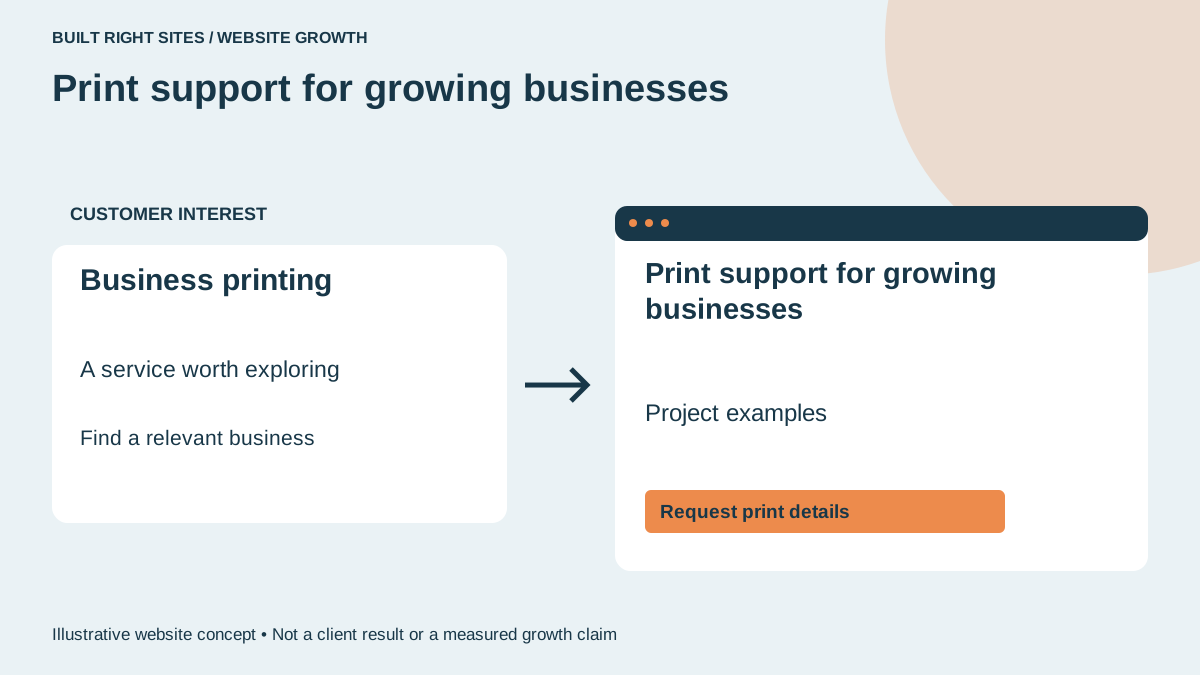
A better homepage can answer that in plain language. It might show sample project types, short descriptions of business printing capabilities, and a visible path to request print details. Built Right Sites offers a homepage concept before deciding to pay, which can be useful if you want to see whether the site structure reflects your actual services, but the main job is still yours: make the offer easy to understand.
Explore websites for printing businesses for an example of how this can work on a site.
Why a generic print catalog can miss the mark
Many print websites try to show everything at once: brochures, banners, business cards, postcards, and more. That can work for some consumer searches, but commercial buyers often need a faster answer. They want to know if your shop can support repeat orders, coordinated materials, or projects with several decision-makers involved. A broad catalog can make a business-focused buyer feel like they are sorting through retail inventory instead of evaluating a production partner.
The fix is not to remove information. It is to organize it around buyer intent. Separate pages for business printing, project examples, and request print details can do more than a long product grid because they help the visitor self-identify. A buyer who sees their situation reflected back to them is more likely to inquire with useful details, which can save time on both sides.
For the next part of this process, read Help trade show buyers find you.
Where discovery fits, and what it cannot do alone
Search discovery can help the right pages get found when someone types a specific service need or problem into a search engine. One search note worth remembering: search snippets may use page content. That means the wording on your pages matters, because it can influence what a buyer sees before they even click.
Still, search is only part of the job. A website cannot create demand out of thin air, and it will not replace a strong sales process or a clear production fit. What it can do is make sure that when a commercial buyer is already looking, your site explains who you help, what kinds of projects you handle, and how to start the conversation without confusion.
Before-and-after wording that changes the inquiry
Before: “We print everything.” After: “Business printing for recurring collateral, openings, and multi-location projects.” Before: “Contact us for a quote.” After: “Request print details for menus, branded inserts, and campaign materials.” The second version does not guarantee more leads, but it gives a buyer a clearer reason to reach out because it speaks to a real use case.
In a hypothetical search journey, a facilities manager might start with a vague need for updated tenant handouts. They land on a page that shows project examples, then move to a request form that asks for quantity, timeline, and use. That path feels different from a generic contact page. It helps the shop qualify the inquiry and helps the buyer feel they are in the right place before any back-and-forth begins.
If your print shop wants more B2B inquiries, the website should function less like a showroom and more like a filter for the right kind of work. Clear service pages, project-focused wording, and an obvious next step can help business buyers decide faster whether to contact you, even though results still depend on the market and follow-through.
Related articles
See how your next website could work
A clear site gives interested customers a useful next step. Explore a homepage for your business, then decide whether it fits.
See my free homepageSources and further reading
- Google: Search snippets — Search snippets may use page content.
Sources checked October 18, 2026. The examples and practical recommendations are our editorial guidance. AI-assisted drafting; reviewed before publication.