Start with partners who already touch sign decisions
Consider businesses involved when a client opens, remodels, or moves into a space: designers, commercial property managers, architects, contractors, and leasing teams. Choose partners whose work gives them a reason to notice a signage need before the customer starts calling shops.
A useful way to choose partners is to look for people who see the project early enough to notice the need for storefront identification, but late enough to know the address, tenant name, or space use. That makes the handoff more practical. A designer preparing a retail opening, for example, may learn that the tenant needs exterior identification, directional signs, or interior wayfinding before the opening date is set.
The goal is not to contact everyone. It is to identify a small set of businesses whose work naturally overlaps with yours and whose clients already need sign decisions.
Build the handoff around permission, location, and project goal
A referral works better when the partner knows exactly what information to pass along. Use a simple handoff: permission, location, and project goal, followed by a named contact who confirms the fit. That is enough to move a lead from a vague interest into a real next step.
Permission matters first. The partner should confirm that the customer is open to being contacted about the sign project. Location comes next because a sign shop needs the address, property context, or site condition to understand what kind of work may be involved. Project goal is the third piece: is the customer trying to identify a storefront, direct visitors, support a new opening, or update old signage?
From there, one named contact should follow up and confirm whether the project matches your scope. That keeps the referral from turning into a long chain of unclear messages. It also helps you avoid promising work before you know what the customer actually needs.
This is also where you can define your own scope in plain language. If you do storefront identification, directional signs, and basic project coordination, say so. If you do not handle a certain type of work, say that too. Clear scope makes a partner more confident about when to send a lead.
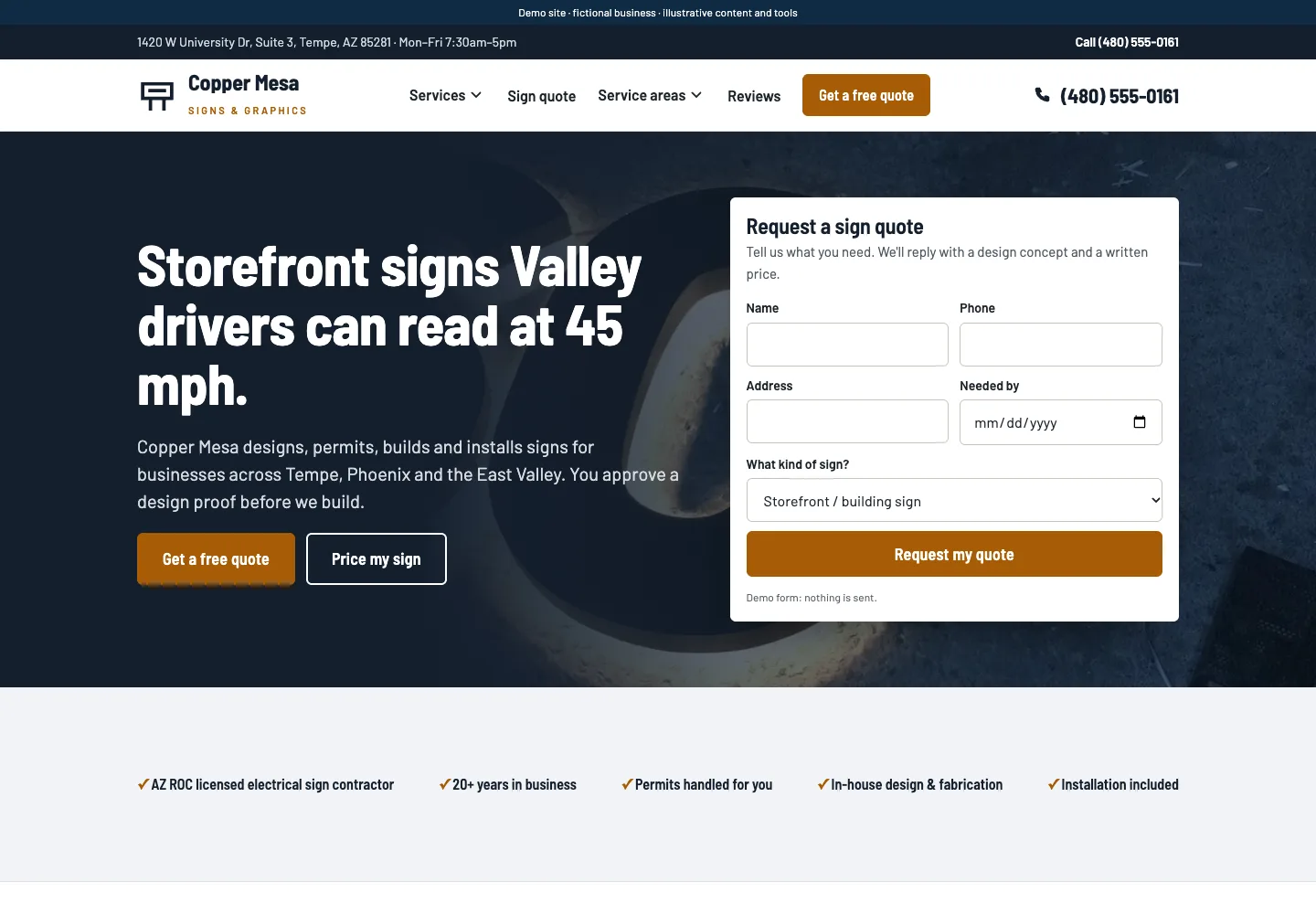
Explore sign-company website layouts for services and project inquiries for an example of how this can work on a site.
Use a handoff page as the partner’s reference point
A handoff page gives partners one place to check what kind of referral belongs with you. It should be simple and easy to scan, not a long brochure. Think of it as the reference page a designer or property manager can pull up when they are deciding whether a tenant issue belongs with your shop.
The page should explain who you help, what information you need, and what happens after the intro. Keep the language practical. For example, a partner should know whether to send a client who needs storefront identification, whether the customer must approve contact first, and whether a named person will respond to confirm the fit.
Do not turn the page into a marketing pitch. It should reduce back-and-forth. If the partner has to guess whether you handle the request, the referral may stall. If they can quickly see the fit, they can hand it off with less friction.
The page can also answer basic process questions that come up often, such as whether the partner should share the site address, the customer’s project goal, and the right name for the next step. That keeps the conversation focused on the job, not on sorting out the referral process from scratch.
For the next part of this process, read Make repeat sign orders easier.
Worked example: a designer sends an opening-day referral
Here is a hypothetical example. A retail designer is helping a new boutique prepare for opening day. During the planning conversation, the designer learns the tenant needs storefront identification and does not yet know who should be contacted next.
The designer’s handoff is simple: “The tenant has permission for a sign conversation, the store is at 1840 Market Street, and the goal is storefront identification for opening day. Please contact Maya Chen to confirm the fit.” That one sentence covers permission, location, and project goal without oversharing.
On your side, the named contact responds with a short confirmation: “Thanks. We handle storefront identification and can review the site details. Please send the customer’s preferred contact method and any property rules that affect the sign.” That keeps the next step clear and professional.
Notice what makes the referral work. It is not a general endorsement or a big promise. It is a clean transfer of enough information to decide whether the project belongs with your shop and what should happen next.
Put this into practice
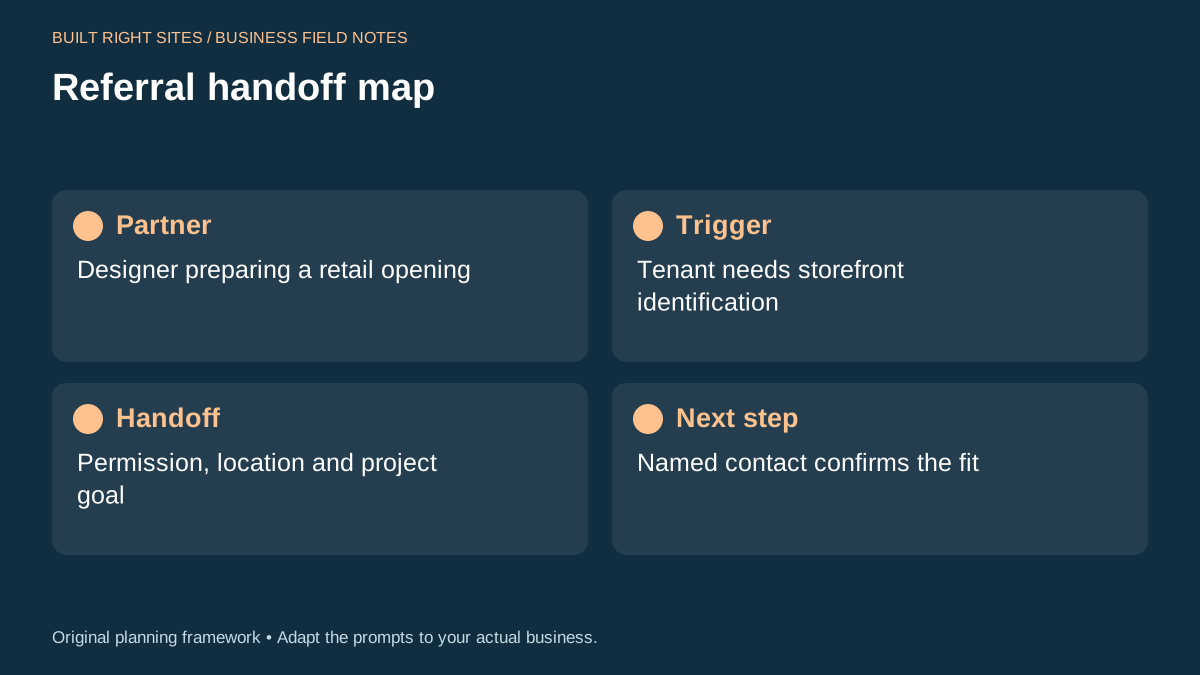
Referral handoff map
- Partner: Designer preparing a retail opening
- Trigger: Tenant needs storefront identification
- Handoff: Permission, location and project goal
- Next step: Named contact confirms the fit
An original planning framework from Built Right Sites, not a validated benchmark.
Keep the partnership usable after the first referral
Once you have a few likely partners, keep the process easy to repeat. That means answering quickly, using the same handoff structure each time, and staying within the scope you already defined. Partners are more likely to refer again when they do not have to relearn your process every time.
It also helps to note what kinds of referrals are and are not a fit. If you only want storefront identification from design and property contacts, say so. If a lead arrives without customer permission, ask for that before moving ahead. If the location is unclear, request the address before discussing the job.
For a sign shop, referral partnerships work best when the handoff is specific and easy to repeat. Focus on the partners who already touch sign decisions, give them a simple reference page, and ask for permission, location, and project goal before the lead moves ahead. That approach keeps the process practical and helps each referral reach the right next step without confusion.
Related articles
See how your next website could work
A clear site gives interested customers a useful next step. Explore a homepage for your business, then decide whether it fits.
See my free homepageSources and further reading
- SBA: Market research and competitive analysis — Customer interviews and competitor research can inform positioning.
Sources checked October 18, 2026. The worksheets and practical recommendations are our editorial guidance. AI-assisted drafting; reviewed before publication.