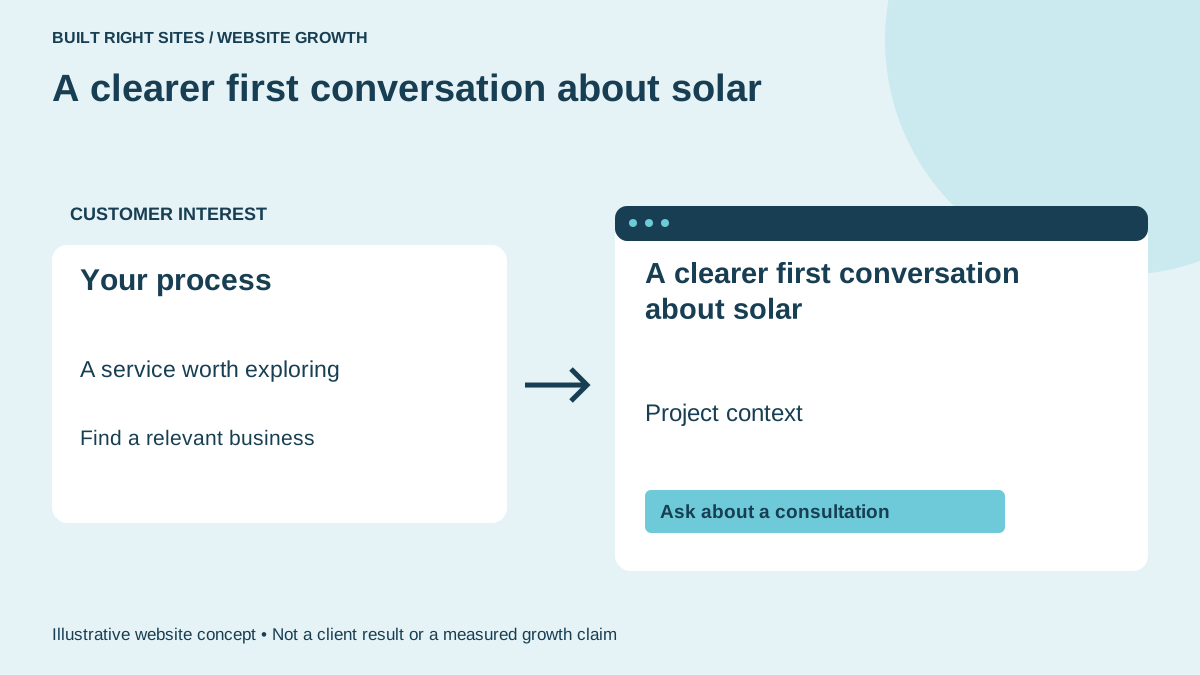
Why homeowners hesitate before they inquire
Many solar visitors are not ready to fill out a form the moment they land on your site. They may be comparing roof conditions, asking whether their home is a good candidate, or trying to understand what happens after they click contact. If the site feels vague, they leave with the same questions they arrived with.
A better site does not pressure them. It reduces uncertainty. A clear homepage can say what kind of projects you handle, who your consultation is for, and what homeowners should expect when they reach out. That shift can make the request feel more relevant and less like a generic sales call.
A consultation page should explain the visit, not just ask for it
The strongest consultation pages answer the questions people are already thinking about. For example: What will you look at? Do I need utility bills? Will someone talk through roof condition, layout, and next steps? Those details help a homeowner decide whether the conversation is worth scheduling.
That is where a website becomes useful for growth. It can frame the consultation as a project-fit conversation instead of a pitch. If someone understands that the purpose is to review their home and talk through options, they are more likely to submit a request that is informed and serious.
Explore websites for solar businesses for an example of how this can work on a site.
A hypothetical homeowner journey from confused to confident
Imagine a homeowner named Carla. She searches for a solar company after noticing her roof has room for panels, but she is unsure whether her house is even a candidate. On one site, she sees a generic headline, a few service buzzwords, and a form that says “Get a quote.” She closes the tab because the next step still feels unclear.
Now imagine a different site. Carla lands on a homepage that explains the company’s process, shows project types, and invites her to request a consultation if she wants a home-specific conversation. She reads a short section that says the visit is for learning about her roof, energy goals, and site conditions. In that version, the request feels like a useful first step, not a leap of faith.
For the next part of this process, read Turn kitchen interest into consultations.
Search discovery helps only when the message matches intent
Some homeowners arrive through search, and that matters because they are often looking for answers before they are looking for a vendor. In that case, a website needs to match the question behind the search. If the page speaks to fit, process, and consultation purpose, it is easier for the visitor to move from curiosity to contact.
Good page experience does not guarantee rankings. That means the website should not be treated as a magic solution. It can improve the clarity of the visit and make discovery more productive, but it cannot promise that every searcher will become a lead or that every lead will be ready to buy.
What changes when the site is built around real buyer intent
A better solar website often sounds less like a brochure and more like a conversation starter. Instead of saying only that you install systems, it can explain what kinds of homes you work with, what the homeowner should bring to a consultation, and how your team approaches the first meeting. Those details help the visitor self-select.
This is also where design choices matter. A clean layout, clear service pages, and plain-language calls to action can keep the focus on the homeowner’s decision. If you are considering a website that reflects your services in a way that feels specific to your market, Built Right Sites offers that kind of starting point, including a homepage concept before you decide to pay.
A solar website can help turn casual interest into better consultation requests when it answers real homeowner questions instead of repeating vague sales language. It works best as a clarity tool: useful for fit, process, and next steps, but not a guarantee of demand or results.
Related articles
See how your next website could work
A clear site gives interested customers a useful next step. Explore a homepage for your business, then decide whether it fits.
See my free homepageSources and further reading
- Google: Page experience — Good page experience does not guarantee rankings.
Sources checked October 18, 2026. The examples and practical recommendations are our editorial guidance. AI-assisted drafting; reviewed before publication.