Start with the inquiry path, not the ad budget
For a small HVAC business, more traffic is not the same thing as more leads. A visitor still has to decide whether to call, fill out a form, or leave and compare you with other companies. If the page does not answer their immediate question, they may not take the next step.
A good first move is to map the path a customer follows from landing on the site to making contact. Look at where the phone number appears, what the main call to action says, how many steps the form takes, and whether the site makes clear who you serve and what kind of HVAC help you offer. This is a practical way to diagnose why an HVAC website is not getting leads before you spend more on ads.
Separate urgent repair, replacement, and maintenance
HVAC lead generation works better when the site treats different customer needs separately. Someone with a broken system is looking for a fast answer. Someone planning a replacement wants details about your process, service area, and how to request a consultation. Someone asking about maintenance wants to know what the visit covers and how to set one up.
If these needs are all pushed into one generic contact page, the visitor has to do extra work. That can create friction. Instead, give each audience a clear path. This does not mean promising availability or outcomes you cannot control. It means making the next step clear for each type of request.
For urgent repair, make the phone number visible and keep the wording direct. For replacement, explain what information you need to start a consultation and what areas you serve. For maintenance, explain the visit in plain language and offer a simple way to request it.
Explore website layouts for HVAC service inquiries for an example of how this can work on a site.
Make contact simple and specific
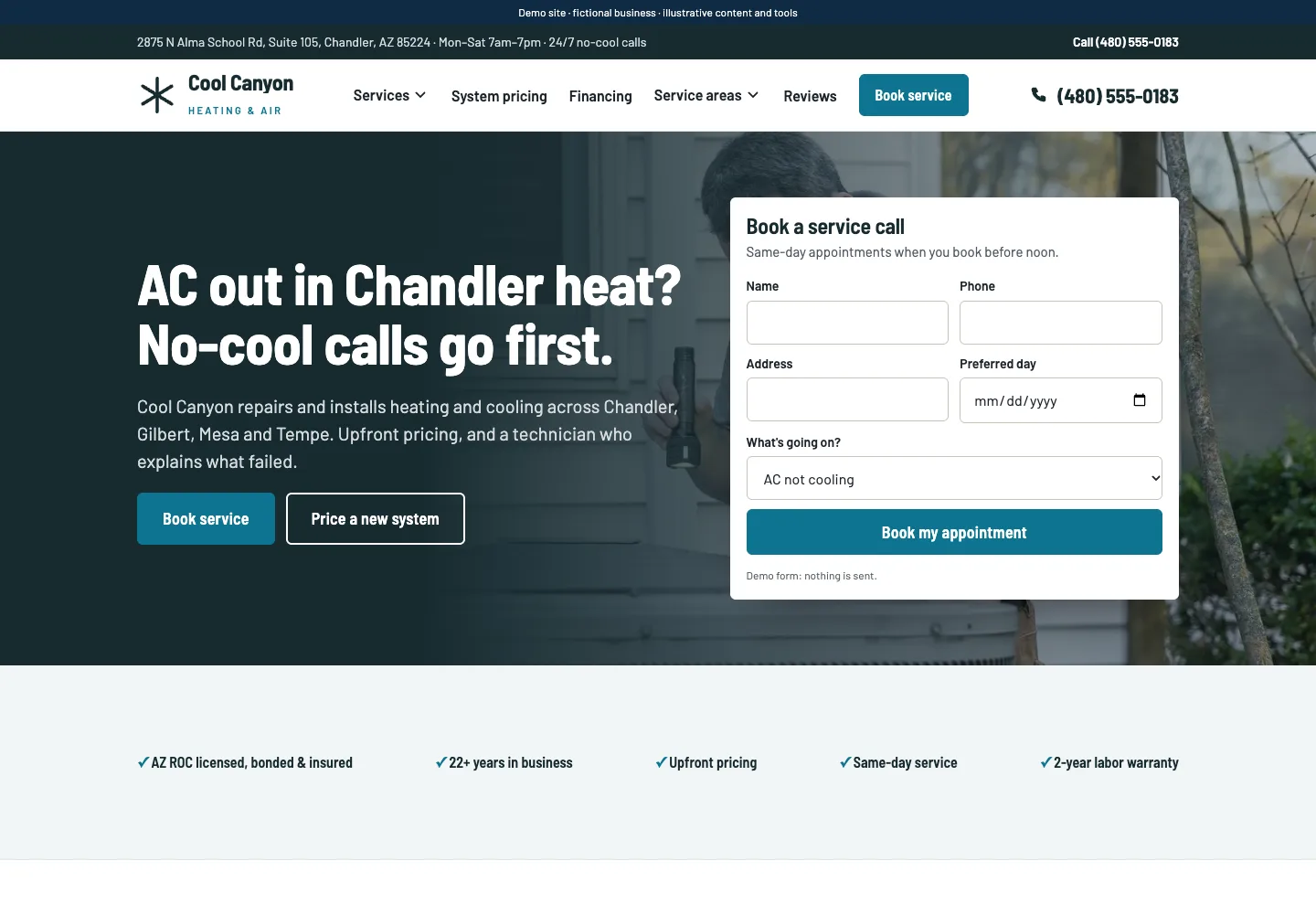
A contact form should ask for only what is necessary to move the request forward. W3C’s form guidance favors concise forms, visible labels, useful feedback, and only the information needed for the process. For an HVAC site, that often means a name, phone or email, service address or ZIP code, and a short description of the need.
The form should make it obvious what happens after submission. People are more likely to complete a form when they understand the next step. Use plain labels, short instructions, and an error message that tells them how to fix a mistake. If a form is too long or vague, visitors may abandon it before sending.
Walk through the site as three different callers
Open your site on a phone and try three scenarios: the cooling has stopped, an older system needs replacing, and someone wants routine maintenance. These are test scenarios, not evidence of your customers’ actual behavior.
For the repair path, check whether the phone number is easy to find and the displayed availability is accurate. For replacement, look for a clear explanation of what happens after an inquiry. For maintenance, check that visitors can understand the service and ask a relevant question without being routed into an emergency request.
Use the inquiry-path worksheet to record the page, the obstacle, and the person responsible for fixing it. Then test the same journey again. A successful test confirms that the contact path works; it does not prove a change increased sales. Compare subsequent inquiries with your own records, allowing for seasonality and small samples.
Put this into practice
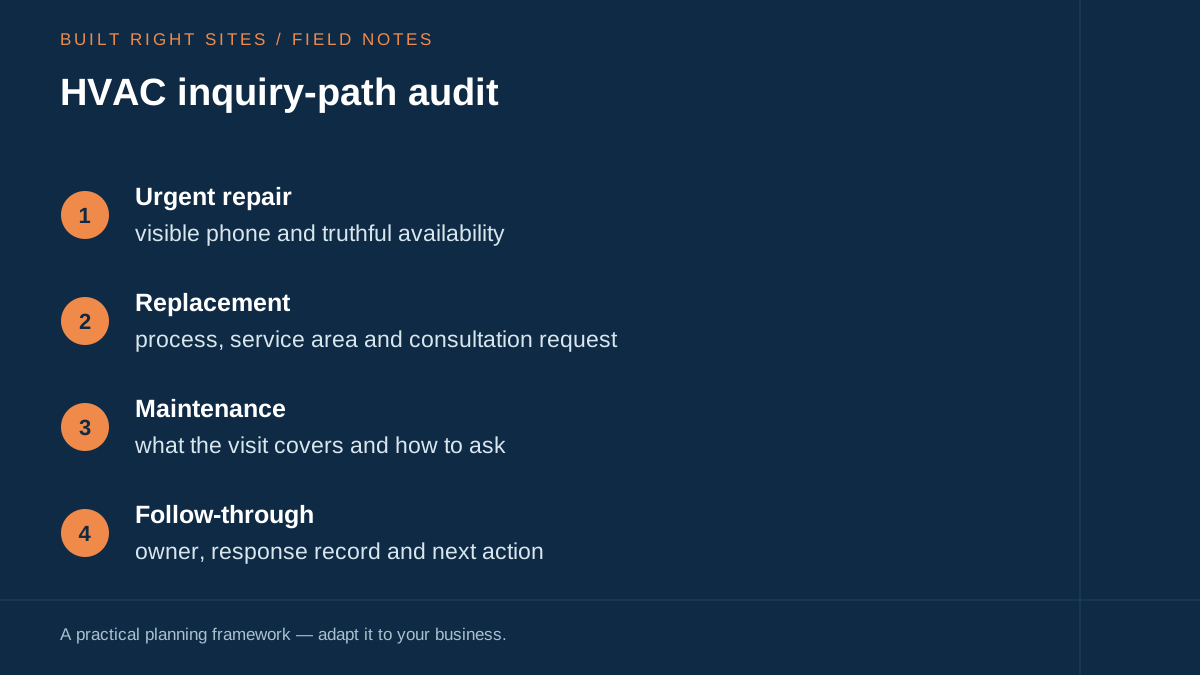
HVAC inquiry-path audit
- Urgent repair: visible phone and truthful availability
- Replacement: process, service area and consultation request
- Maintenance: what the visit covers and how to ask
- Follow-through: owner, response record and next action
An original planning framework from Built Right Sites, not a validated benchmark.
Tighten your local business information
Google says local ranking depends on relevance, distance, and prominence. It also says business information should be complete and accurate, and that rankings cannot be bought. That means your site and business profile should agree on the basics: name, address or service area, phone number, and what you do.
This is not just a search issue. Customers may hesitate if one page says one thing and another page says something different. Make sure your service area, hours, contact details, and main service categories are consistent across the site and business listings you control.
Follow through on every inquiry
Getting a form submission or phone call is not the final step. The follow-through process matters because it determines whether a lead gets answered, recorded, and moved to the next action. If calls are missed, forms sit unanswered, or no one owns the response, the traffic you already have may not turn into real opportunities.
Set a simple internal process. Decide who checks messages, who responds first, and what happens when the original contact is not reachable. Keep a basic response record so you can see whether inquiries are being handled. This does not need to be complicated; it just needs to be consistent.
Before changing your HVAC advertising budget, check whether interested visitors can take the right next step. Separate repair, replacement, and maintenance requests, test the contact paths, and assign someone to follow up. Your own inquiry records can help you decide whether the next priority is traffic, the website, or the response process.
Related articles
See how your next website could work
A clear site gives interested customers a useful next step. Explore a homepage for your business, then decide whether it fits.
See my free homepageSources and further reading
- Google: Tips to improve your local ranking — Google describes local ranking through relevance, distance and prominence. Keep business information complete and accurate; rankings cannot be bought.
- W3C: Forms tutorial — Use concise forms with visible labels, instructions and useful feedback. Request only information necessary for the process.
Sources checked October 18, 2026. The worksheets and practical recommendations are our editorial guidance. AI-assisted drafting; reviewed before publication.