Start with one buyer-job pairing
A sign shop can sell many things, but your marketing works better when it starts with one clear pairing. Pick one buyer and one job type that fit together well. For example, a retailer preparing to open may need storefront identification. A contractor may need fleet graphics. An organizer may need temporary event signage.
This is more useful than trying to market every service at once. When you focus on one pairing, your message can speak to a specific situation, the proof you show can look relevant, and your follow-up questions can be more direct.
Build proof that matches the job
People usually want to see work that looks like the job they need. Use finished-project photos that show the sign in context, not just close-up details. For a storefront project, show the sign on the building or in a real setting. For fleet graphics, show the installed vehicle. For temporary signage, show the sign being used at an event or location where it makes sense.
Keep the proof tied to the exact offer. If you are promoting storefront identification, show storefront identification. If you are promoting fleet graphics, show fleet graphics. That makes it easier for a visitor or referral to imagine the same kind of result for their own business.
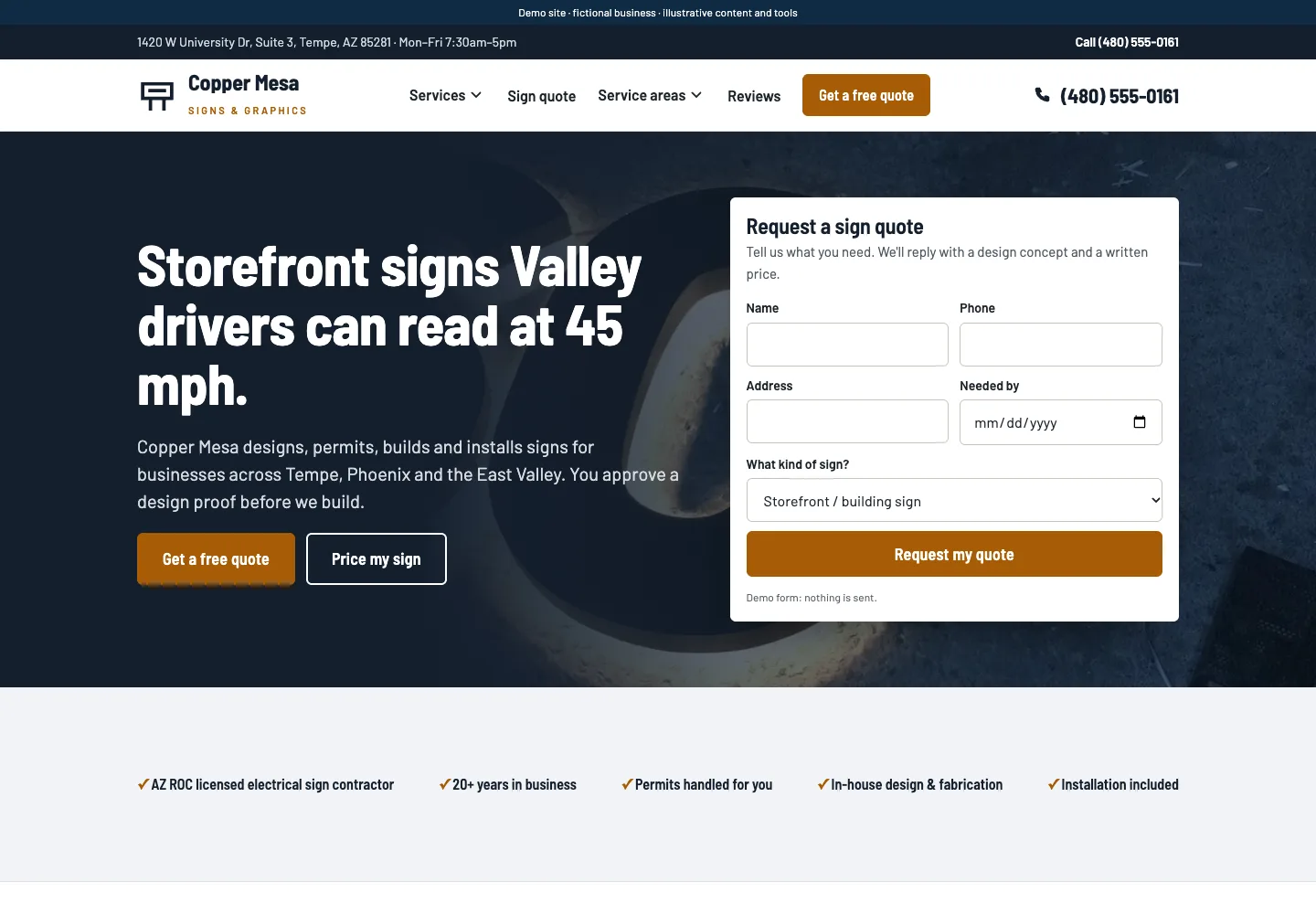
See how a sign-company website can organize services and quote requests for an example of how this can work on a site.
Make inquiries easier to act on
A website or intake form should not just collect a name and phone number. It should help the inquiry move forward. Ask for the details you need to respond well: location, opening date, sign type, and whether the request is for storefront identification, fleet graphics, or temporary event signage.
That approach saves time on both sides. It helps you sort the request, decide whether it fits your work, and prepare a more useful reply. It also gives the prospect a clearer sense that you understand the project.
Do not rely on the website alone to create demand. It is one part of the system. Referrals, repeat customers, local relationships, and direct outreach still matter, especially for a sign company that serves a local market.
Build a campaign around one opening-date problem
Here is an example you can adapt: choose independent retailers preparing to open a location. Your offer is storefront identification, your proof is an approved photo of a similar installation, and your first question is when the location needs to open. This is a hypothetical campaign, not a customer success story.
Put those details into the opportunity worksheet. Next, choose a relevant relationship: a commercial property manager, designer, or contractor you already know. Share a useful example and explain what details help you assess a project. A focused introduction gives that person something concrete to pass along.
Keep a simple record of the source, requested sign type, next action, quote status, and eventual outcome. If requests are mostly outside your service area, change the audience or location wording. If suitable inquiries stall at artwork, improve the artwork instructions. Judge the next change from what actually happened, not from page views alone.
Put this into practice
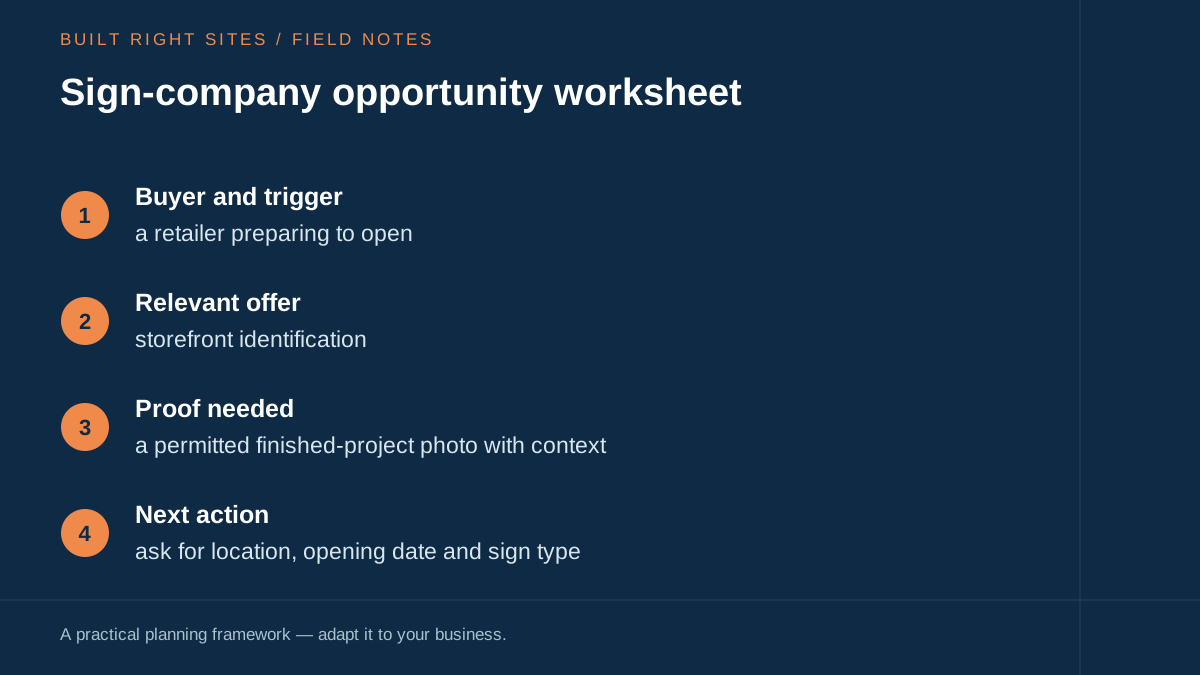
Sign-company opportunity worksheet
- Buyer and trigger: a retailer preparing to open
- Relevant offer: storefront identification
- Proof needed: a permitted finished-project photo with context
- Next action: ask for location, opening date and sign type
An original planning framework from Built Right Sites, not a validated benchmark.
Reach the relationships already around your shop
For a sign company, some of the best opportunities often come from people who already know the buyer or influence the project. That can include contractors, property managers, designers, event planners, architects, real estate contacts, and other local business owners. You do not need a huge campaign to make this work. You need a clear offer, relevant examples, and a simple way for people to refer the right project.
Think about who is likely to hear about a new opening, a vehicle refresh, or an upcoming event before you do. Then make sure those contacts know what kind of work you want, what information you need to start, and how to send a lead your way.
Use reviews and local visibility the right way
Local visibility matters because people often search nearby when they need a sign shop. Keep your business information complete and accurate wherever it appears online. That includes name, address, phone number, service areas, and the kinds of work you actually do. Google says local ranking is based on relevance, distance, and prominence, so the information you present should match the work you want to be found for.
Reviews can help too, but they should be honest and requested the right way. Ask customers for an honest review using the same neutral request process. Do not offer incentives, and do not ask only for positive feedback. Do not restrict the request to people you expect to leave positive feedback.
The most practical way to get more business for a sign company is to narrow the target, show the right proof, make inquiries easier to handle, and stay active in the relationships that already connect you to buyers. A website can support that work, but it should not carry the whole plan. When you focus on one buyer-job pairing and measure real jobs instead of impressions, you have a clearer way to decide what to repeat and what to change.
Related articles
See how your next website could work
A clear site gives interested customers a useful next step. Explore a homepage for your business, then decide whether it fits.
See my free homepageSources and further reading
- Google: Tips to improve your local ranking — Google describes local ranking through relevance, distance and prominence. Keep business information complete and accurate; rankings cannot be bought.
- Google: Tips to get more reviews — Ask for honest reviews using a review link. Do not offer incentives or selectively solicit positive feedback.
Sources checked October 18, 2026. The worksheets and practical recommendations are our editorial guidance. AI-assisted drafting; reviewed before publication.